Skip to content

Posts from the ‘Spain’ Category

Urbanism and Dictatorship – A European Perspective

Publication edited by Harald Bodenschatz, Piero Sassi and Max Welch Guerra (Birkhäuser Verlag, Bauwelt Fundamente 153, 2015)

Harald Bodenschatz, Technische Universität Berlin, harald.bodenschatz@tu-berlin.de
Piero Sassi, Bauhaus-Universität Weimar, piero.sassi@uni-weimar.de
Max Welch Guerra, Bauhaus-Universität Weimar, max.welch@uni-weimar.de

Urban design under European dictatorships in the first half of the twentieth century must be considered in an international context, as the professional and cultural exchange between European countries was – beyond conflicts and political orientations – very intensive. This European perspective allows us to recognize the specificities of old and new forms of dictatorship!

Download flyer: Urbanism_and_Dictatorship_2015

Urbanism_and_Dictatorship

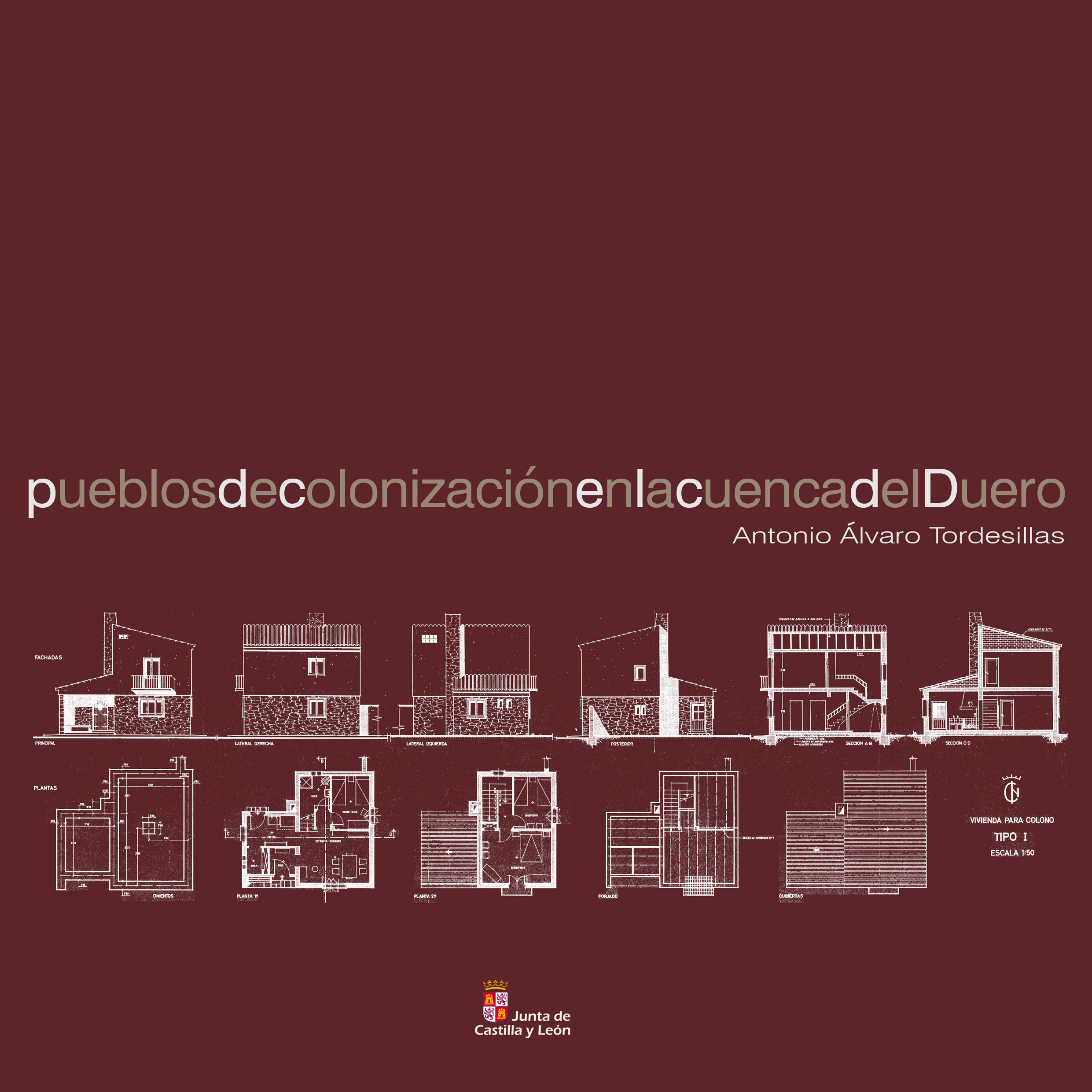
Pueblos de colonización en la cuenca del Duero

book by Antonio Álvaro Tordesillas, published by the Junta de Castilla y León in 2010

Antonio Álvaro Tordesillas, Universidad de Valladolid, tordesillas@arq.uva.es

Son muchos los estudios elaborados sobre el tema de la Colonización en España, pero es éste el primero que lo hace sobre el territorio de Castilla y León. El libro estudia y analiza 21 pueblos repartidos por la Comunidad que se proyectaron y levantaron de nueva planta, en las décadas de los cuarenta, cincuenta y sesenta, bajo la dirección del Instituto Nacional de Colonización. Pueblos que constituyen conjuntos claramente identificables y de elevado valor histórico y material, esenciales para comprender la compleja transición a la modernidad en la que, en la segunda mitad del siglo XX, se encontraba inmersa la arquitectura en España.

Por otro lado, la manera cómo se enfoca y trata el tema de la Colonización, es asimismo novedoso especialmente por las numerosas y continuas referencias a otros momentos e hitos del urbanismo y la arquitectura, en un momento crucial también fuera de nuestro país. De tal manera, que quizá el título resulte engañoso, al tratarse de un completo, exhaustivo e interesante análisis de la Colonización en nuestro país: desde la escala territorial hasta la habitacional, tanto urbana como arquitectónicamente, y relacionándola con la propia historia y evolución de la arquitectura nacional e internacional (la Unidad Vecinal americana, la Ciudad Jardín inglesa, la Bonifica Integrale italiana, la vivienda mínima en Europa, etc.).

Es por ello que en la definición de este corpus teórico, no se centre exclusivamente en ejemplos de la Cuenca del Duero, sino con los casos más paradigmáticos y representativos de la Colonización española. Pueblos como Vegaviana, Sacramento, Esquivel o Villalba de Calatrava son examinados y comparados con otros como Radburn, Harlow, La Martella o Nahalal, por citar algunos; con trazados urbanos como los del Seminario de urbanología de Fonseca; con los concursos anteproyectos para la construcción de poblados residenciales de la OPER o los del Agro Pontino italiano; con tipologías edificatorias como las del Instituto de la Vivienda, el tercer Reich alemán, la vivienda Amann, o las de los Poblados Dirigidos de Madrid.

Además, este trabajo posee un carácter indudablemente documental ya que supone, por un lado, dar a conocer este patrimonio, y por otro proponer, o en todo caso servir de fundamento y ayuda, para el desarrollo de instrumentos específicos para la evaluación y reflexión sobre su recuperación, protección, difusión y explotación. No cabe duda, que es una gran oportunidad de promoción cultural, investigación y revisita de nuestro inmediato pasado.
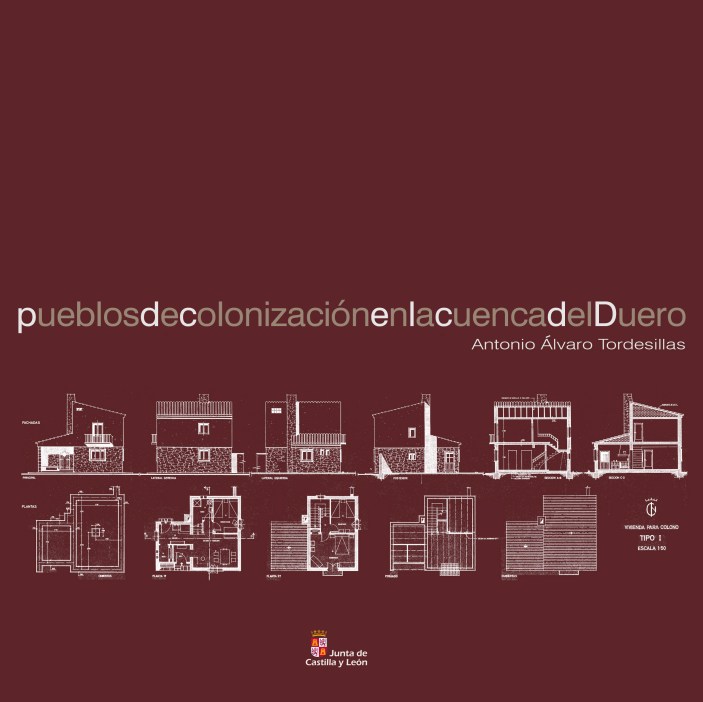
Portada libro

Städtebau und Diktatur unter Salazar und Franco – eine europäische Perspektive

Vorstellung des gleichnamigen Forschungsprojekts an der Universität Kassel am 29. Oktober 2014

Uwe Altrock, Universität Kassel, altrock@asl.uni-kassel.de

Im Rahmen der Vortragsreihe des Fachbereichs Architektur, Stadt- und Landschaftsplanung stellten Prof. Dr. Harald Bodenschatz (TU Berlin), Christian von Oppen (TU Berlin) und Piero Sassi (Bauhaus-Universität Weimar) erste Ergebnisse eines DFG-geförderten Forschungsprojekts vor.

Harald Bodenschatz ging auf den Forschungsrahmen und den Kontext des Projekts ein, in das das Fachgebiet Stadtumbau/Stadterneuerung an der Universität Kassel informell eingebunden ist. Von besonderer Relevanz erscheint für den deutschen Forschungskontext und die internationalen Verflechtungen der Diktaturen in Europa nicht zuletzt, mit welch großem Aufgebot deutsche und italienische Truppen am spanischen Bürgerkrieg teilnahmen und wie groß die Schuld ist, die sie auf sich luden – nicht nur bei der Zerstörung der baskischen Stadt Gernika. Bodenschatz erinnerte auch an die außerordentliche Rolle, die Lissabon Anfang der 1940er Jahre für kurze Zeit als Treffpunkt von Flüchtlingen aus ganz Europa spielte. Verblüffend aus heutiger Sicht erscheint, dass berühmte Wahrzeichen der Stadt wie das Hieronymus-Kloster in ihrem städtebaulichen Umfeld stark von der Diktatur beeinflusst wurden oder die Diktatur auf eine Ebene mit der Größe des untergegangenen portugiesischen Weltreichs stellt wie das 1960 errichtete Denkmal der Entdeckungen.

In diesem Sinne machten auch Christian von Oppen und Piero Sassi anhand von Einzelprojekten deutlich, dass der Städtebau unter den iberischen Diktaturen weit über staatliche Repräsentationsbauten hinausreichte und sowohl stilistisch als auch im Hinblick auf die Stadtproduktion nicht leicht einzuordnen ist. Bekannter sind vielleicht noch Orte wie das Tal der Gefallenen als spanisches Nationalmonument zur Verherrlichung der Franco-Diktatur. Weniger bekannt sind dagegen vermutlich die starken Einflüsse der Diktatur auf den Städtebau in Madrid sowie die Projekte zum Bau von Universitäten in Lissabon und Coimbra, die ein breites Spektrum von städtebaulichen Zugängen offenbaren.

Plakat_Fusion

Urban Design and Authoritarian Government – European Dictatorships in the 20th Century in International Perspective

Roundtable Discussion funded by the German Research Foundation at the University of Kassel on 25 and 26 August 2014

Uwe Altrock, Universität Kassel, altrock@asl.uni-kassel.de
Harald Kegler, Universität Kassel, harald_kegler@yahoo.com

To strengthen the network of researchers working on 20th century dictatorships in Europe and urban development, researchers from the University of Kassel, TU Berlin and Bauhaus University Weimar hosted a roundtable discussion. About 20 scholars from Germany and abroad discussed avenues for a more systematic research and perspectives for the funding of research networks. The underlying idea was that there is a lot of detailed research in a number of European countries that have witnessed dictatorships in the 20th century especially when it comes to matters of architectural form, whereas a broader approach transcending this narrow perspective is only gradually established. The following questions seem to need a more thorough reasearch approach that is truly international in nature and may allow for comparisons and for significant contributions in the context of the contemporary perception of legacies of dicatorships in a democratic environment:

How is an authoritarian system of urban design established?
Are there specific products and traditions of urban form?
How is urban design in dictatorships influenced by international exchange both in political and professional terms?
What are the specific features of the production of urban space in dictatorships when looking beyond representational urban design for the state itself?
The roundtable discussion offered an opportunity for productive interdisciplinary exchange between scholars from the fields of architecture, planning, history, history of art, preservation and political science that have all contributed to the overall theme of the roundtable discussion.
In the future, research activities of the participants will build on completed and on-going projects dealing with the situation in, among others, Germany, the Soviet Union, Italy, Spain, Portugal, and the Balkans, and linking it more actively with the activities of networks such as UEDXX.

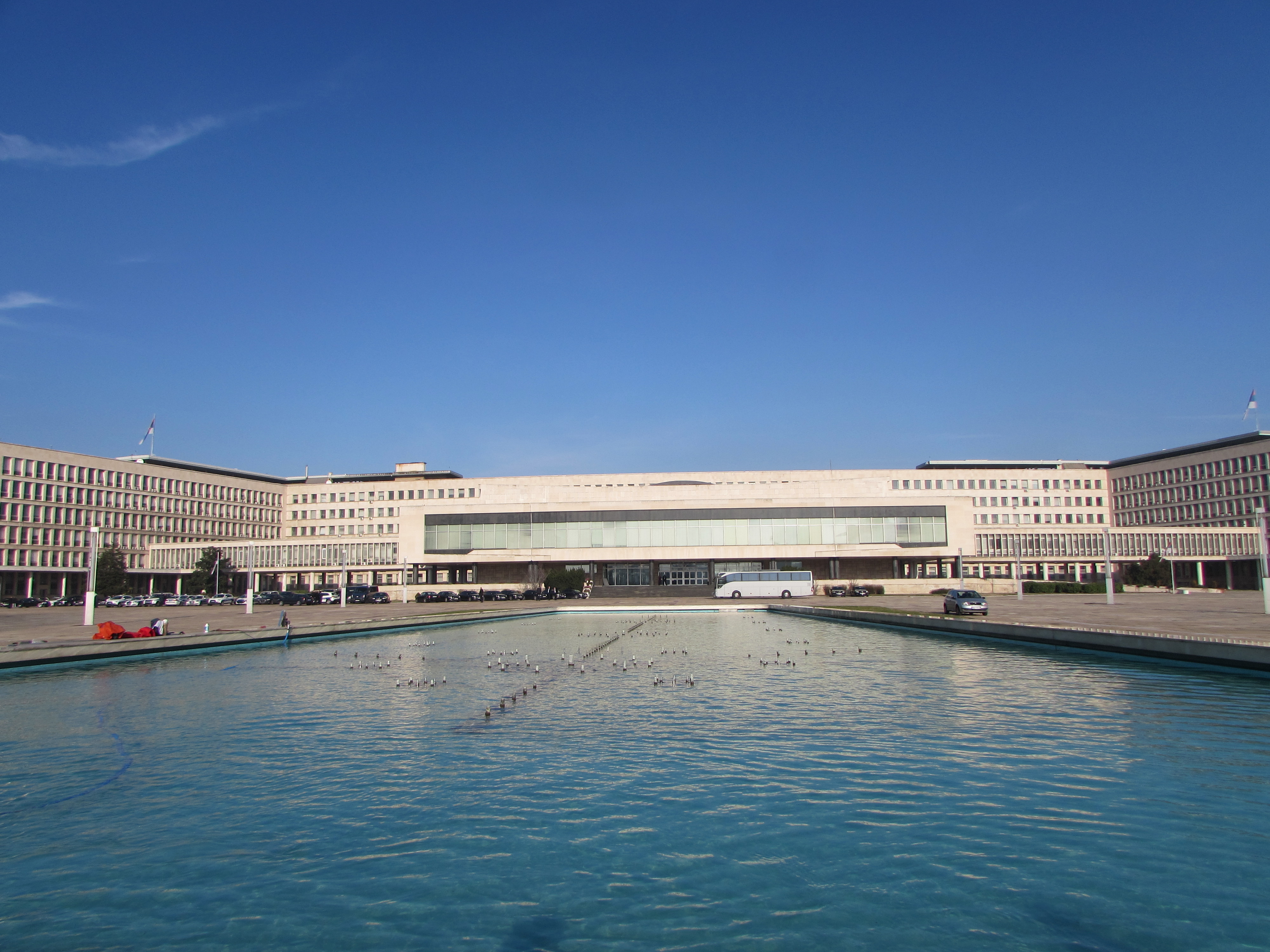
1 ehemal parlament jugoslawiens 1961

Former Parliament of Yugoslavia (inaugurated in 1961), nowadays Parliament of Serbia. The built legacy left behind by the dictatorship in former Yugoslavia was discussed during the presentation “Research on Forgotten Dictatorships” (Harald Kegler). Photograph by Harald Kegler 2014, CC BY-NC-ND 4.0

Städtebau und Diktatur: mehr als ein Forschungsprogramm

Article by Harald Bodenschatz in: Forum 2014, 69-70

Harald Bodenschatz, Technische Universität Berlin, harald.bodenschatz@tu-berlin.de

Nach den Forschungen zum Städtebau in der frühen Stalinzeit und in der Mussolinizeit haben wir – Max Welch Guerra, Uwe Altrock, Christian von Oppen, Piero Sassi und ich – dank der DFG die Chance, Forschungen zum Städtebau der Diktaturen auf der iberischen Halbinsel durchzuführen. Auch die Diktaturen Salazars und Francos sind Teil unserer gemeinsamen europäischen Geschichte. Auch ihr Städtebau ist Teil der europäischen Städtebaugeschichte, und der Umgang mit diesen Zeugnissen betrifft uns alle.

Download full text: Städtebau_und_Diktatur_Bodenschatz

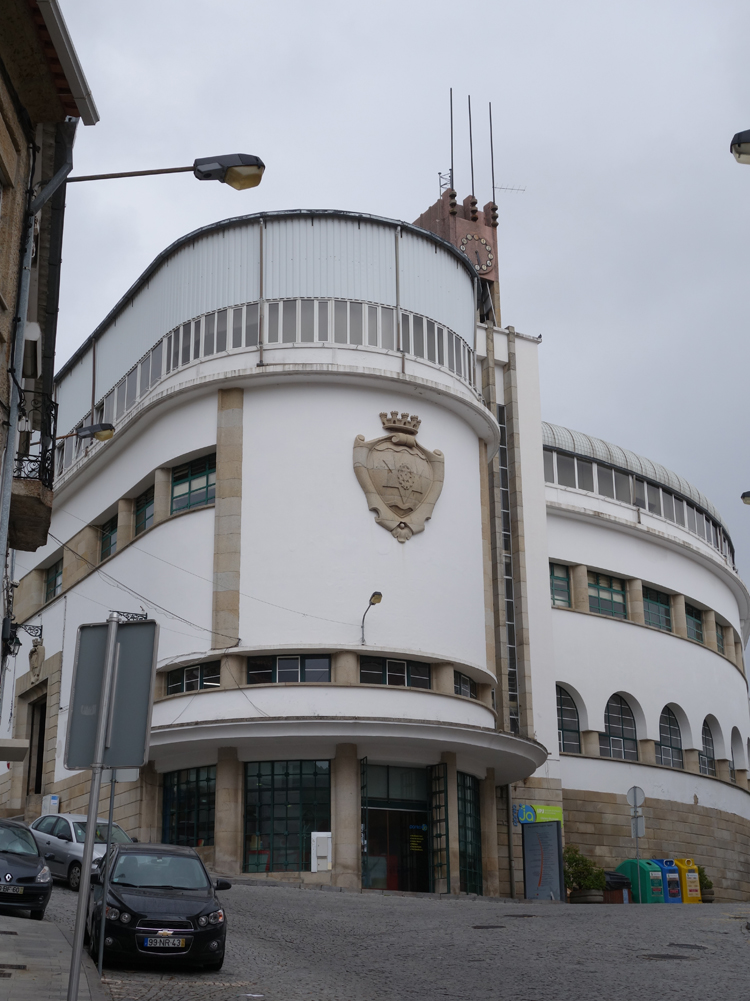
Mercado

Mercado General de Covilhã, (eröffnet 1943, erneuert 2000). Foto: Harald Bodenschatz 2014, CC BY-NC-ND 4.0

Urban Design for Mussolini, Stalin, Salazar, Hitler and Franco during the Interwar Period

Session M50 at the 12th International Conference of the European Association for Urban History (Lisbon, September 3–6, 2014)

Christian von Oppen, Technische Universität Berlin, christian.von.oppen@uni-weimar.de

Earlier this year, the UEDXX for the first time participated in the European Association for Urban History (EAUH) biannual conference in Lisbon. The EAUH conference provides a multidisciplinary forum for the diverse community of urban scholars. Following this multidisciplinary approach, Prof. Dr. Harald Bodenschatz, DI Christian von Oppen and Prof. Dr. Max Welch Guerra (founding members of the network) organized a session about urban design under the European dictatorships of the 20th Century (“Urban Design for Mussolini, Stalin, Salazar, Hitler and Franco during the Interwar Period”, M50). The session mainly focused on an international approach, which was underlined by six contributions representing six different countries.

Due to the forced repression of other European countries, as well as the cultural diplomacy of the most powerful dictatorships of the 20th century (for example, the Soviet Union, Nazi Germany, and Fascist Italy), urban history under dictatorial regimes is a topic with broad international reference. Nevertheless, this important topic is mainly discussed within the single national contexts. During the session, the different contributions made clear that the understanding of the common European history under dictatorships is determined by different national experiences. It is necessary to overcome this gap to achieve a shared understanding of the European history of the 20th Century.

Accepted papers will be published on this website.

Conference session (M50):
http://www.eauh2014.fcsh.unl.pt/index.php?conference=conference&schedConf=eauh2014&page=schedConf&op=trackPolicies

Download short report (German): Bericht_SessionM50

140829_UEDXX

The UEDXX network was presented during the networking event on Thursday, September 4, 2014, CC BY-NC-ND 4.0.

Towards a History of European Urbanism in the 20th Century: Questions and Challenges. Perspectives from Spain, France and Germany

Hacia una historia del urbanismo europeo del siglo XX: cuestiones y desafíos. Miradas desde España, Francia y Alemania

Seminar at the Instituto Universitario de Urbanística, Universidad de Valladolid

Álvaro Sevilla Buitrago, Universidad Politécnica de Madrid, alvaro.sevilla@upm.es

Cartel historia del Urbanismo.pdf

Los pasados días 17 y 18 de octubre se celebró en la Universidad de Valladolid el encuentro “Hacia una historia del urbanismo europeo del siglo XX: cuestiones y desafíos. Miradas desde España, Francia y Alemania“. El evento forma parte de un proyecto conjunto entre centros de estos países para difundir el conocimiento y la crítica de la historiografía del urbanismo europeo del siglo XX. Fue organizado por Instituto Universitario de Urbanística con la profesora María Castrillo Romón al frente y contó con la participación de los profesores Alfonso Álvarez Mora, Laurent Coudroy de Lille, Max Welch Guerra, Juan Luis de las Rivas, Charlotte Vorms, Luis Santos Ganges, Álvaro Sevilla Buitrago y José Luis Lalana, y los investigadores Marina Jiménez, Víctor Pérez Eguíluz, Miguel Fernández, Christian von Oppen y Piero Sassi. La discusión fue interesante y, por momentos, apasionada, aunando las lecturas monográficas sobre problemas regionales y nacionales con análisis comparados a nivel internacional y reflexiones sobre la propia metodología, planteamientos y objetivos de la historia del urbanismo frente a otras formas de historiografía. El encuentro permitió el intercambio de las distintas experiencias y acercamientos practicados en los centros participantes (Bauhaus-Universität Weimar, Institut d’Urbanisme de Paris y Universidad Politécnica de Madrid, además de la propia Universidad de Valladolid). A la luz del debate quedó claro que para los ponentes el conocimiento del pasado no es un mero complemento ornamental al ejercicio urbanístico, sino una auténtica oportunidad para comprender el porqué de nuestras técnicas y discursos y las dinámicas que regulan las ciudades y territorios contemporáneos.

Están disponibles en vídeo todas las sesiones del encuentro: http://institutourbanistica.com/videos-curso-uva-hacia-una-historia-del-urbanismo-europeo-del-siglo-xx-cuestiones-y-desafios/

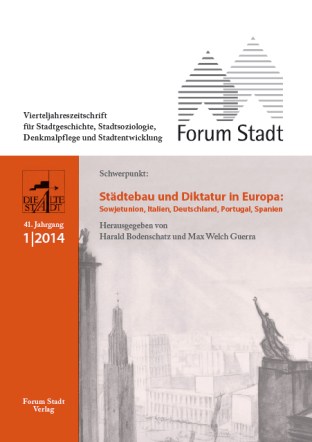
Städtebau und Diktatur in Europa: Sowjetunion, Italien, Deutschland, Portugal, Spanien

Forum Stadt. Vierteljahreszeitschrift für Stadtgeschichte, Stadtsoziologie, Denkmalpflege und Stadtentwicklung. 41. Jahrgang 1/2014

Publication edited by Harald Bodenschatz and Max Welch Guerra

Harald Bodenschatz, Technische Universität Berlin,  harald.bodenschatz@tu-berlin.de

2014-1 Zeitschrift Forum Stadt.indb

Aus dem Editorial:

„Die deutschsprachige Forschung zur Städtebaugeschichte der europäischen Diktaturen der Zwischenkriegszeit hat sich aus verständlichen Gründen jahrzehntelang auf das nationalsozialistische Deutschland konzentriert, Studien über den Städtebau anderer Diktaturen dieser Jahre blieben eine Ausnahme. Dies ändert sich langsam. Dabei sind ganz unterschiedliche Sichtweisen zu beobachten, vor allem historische, kunst- bzw. bauhistorische, planungsgeschichtliche sowie politik- bzw. sozialwissenschaftliche Betrachtungen, die oft wenig untereinander kommunizieren. Damit sind zwei Käfige benannt, in denen sich die noch tastende und wenig systematisch vernetzte Forschung bewegt: nationale Grenzen und disziplinäre Schranken.

Das folgende Heft versteht sich als ein weiterer Schritt in Richtung vernetzter Forschung über nationale und disziplinäre Grenzen hinaus. Es thematisiert unterschiedliche europäische Diktaturen der Zwischenkriegszeit, vor allem solche längerer Dauer, und die Autoren repräsentieren unterschiedliche Disziplinen: Architektur, Kunstgeschichte, Kulturphilosophie, Planungswissenschaften, Politikwissenschaften und Soziologie. Gemeinsam ist ihnen allen eine langjährige Erfahrung in der Kooperation mit anderen Disziplinen.“

Inhaltsverzeichnis:
http://d-nb.info/1048465764/04

City Production by Iberian Dictatorships in the European Context

Research project at the Bauhaus University Weimar, Technical University Berlin and University of Kassel

Städtebau unter der Diktatur – ein Forschungsprojekt zu Portugal und Spanien

Welche Rolle spielte der Städtebau unter den heute noch nachwirkenden Diktaturen von António Salazar und Francisco Franco? Wie sehr sind die Fachleute, die für beide iberischen Regimes gearbeitet haben, und ihre Werke Teil einer gemeinsamen Geschichte des europäischen Städtebaus im 20. Jahrhundert?

Piero Sassi, Bauhaus-Universität Weimar, piero.sassi@uni-weimar.de

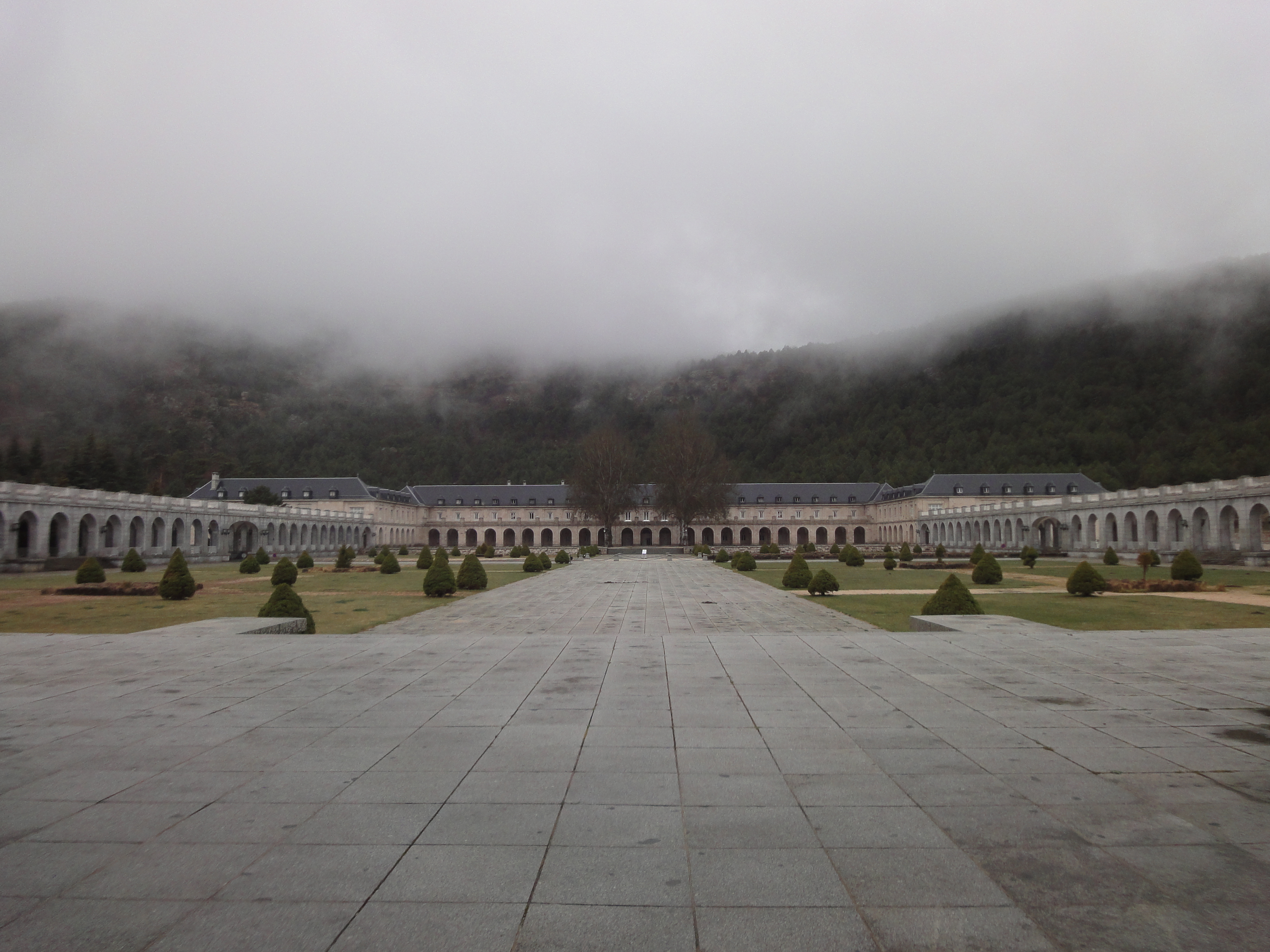
Benediktinerabtei im Valle de los Caídos (Tal der Gefallenen) bei Madrid, Hauptmonument der spanischen Diktatur Francos, Mausoleum und Grabstätte des Diktators, errichtet 1940 bis 1959. Foto: Harald Bodenschatz, 2012

Benediktinerabtei im Valle de los Caídos (Tal der Gefallenen) bei Madrid, Hauptmonument der spanischen Diktatur Francos, Mausoleum und Grabstätte des Diktators, errichtet 1940 bis 1959. Foto: Harald Bodenschatz, 2012

Vom 1. April 2014 an wird das von der DFG geförderte Forschungsprojekt “Städtebau unter Franco und Salazar, Stadtproduktion iberischer Diktaturen im europäischen Kontext” eine Antwort auf diese und weitere Fragen suchen. Das Projekt ist Teil eines Forschungsverbundes zur Planungsgeschichte des 20. Jahrhunderts unter dem Dach des Bauhaus-Instituts für Theorie und Geschichte der Architektur und der Planung und knüpft insbesondere an Vorarbeiten zum Städtebau unter den Diktaturen Hitlers, Mussolinis und Stalins an.

Es wird an der Bauhaus-Universität Weimar (Prof. Welch Guerra, Raumplanung und Raumforschung) und an der TU Berlin (Prof. Bodenschatz, Center for Metropolitan Studies) unter Beteiligung von Prof. Altrock (Universität Kassel) durchgeführt. Wissenschaftliche Mitarbeiter sind Christian von Oppen und Piero Sassi, studentische Mitarbeiterinnen: Maria Victoria Cura, Marie Kötterheinrich und Tatjana Zemeitat.

Zeitlich bezieht sich das Projekt auf die Kernphasen des staatlich gesteuerten Städtebaus, der in Portugal unter António de Oliveira Salazar 1928 und in Spanien unter Francisco Franco im Jahr 1939 beginnt, sehr stark unter dem Einfluss des faschistischen Italiens und Nazi-Deutschlands stand und in den späten 1950er an Bedeutung verliert.

Für Rückfragen steht Ihnen gern Piero Sassi, wiss. Mitarbeiter Professur Raumplanung und Raumforschung der Fakultät Architektur und Urbanistik an der Bauhaus-Universität Weimar zur Verfügung (Tel. +49 (0) 3643 / 58 26 05, E-Mail: piero.sassi[at]uni-weimar.de)

4

Eingang in das Viertel Terras de Forno, ein 1933 bis 1938 realisiertes Projekt des sozialen Wohnungsbaus der Salazarzeit in Belém, Lissabon. Foto: Harald Bodenschatz, 2012, CC BY-NC-ND 4.0