Skip to content

An Urban History of the Twentieth Century? Historiographic reflexions

Call for papers, Ciudades 19 (2016)

María Castrillo Romón, Universidad de Valladolid, mariacr@arq.uva.es

logo_Ciudades_A

We are currently celebrating the centenary of the first movements, exhibitions, congress and competitions on urbanism which took place in Europe. For this reason several scientific meetings encourage the discussion on history of urbanism and towns on the Twentieth Century. For essence, journal Ciudades dedicated its 6th issue (2001) to the centenary of the launch of “Garden Cities of Tomorrow” (http://www3.uva.es/iuu/ciud06.htm); the Berlin University of Technology has inaugurated the exhibition “City visions 1910 / 2010. Berlin Paris London Chicago. 100 years General Urban Design Exhibition in Berlin (‘Allgemeine Städtebau-Ausstellung in Berlin’)” (http://architekturmuseum.ub.tu-berlin.de/index.php?set=1&p=451&LANG=EN); a powerful group of research laboratories located in Paris have already organised two congress on the topic “Inventer le Grand Paris”, starting with the works of the Commission of Extension of Paris from 1913 to 1919 (http://www.citechaillot.fr/fr/auditorium/colloques_conferences_et_debats/colloques/25377-inventer_le_grand_paris.html), and the Bauhaus Universität Weimar is preparing the commemoration of its own foundation.

All these germinal events have in common their internationality. Whether these celebrated facts arose with the ‘international’ feature or they have acquired it because of the expansion out of the own country, they give proof of a speech that has gone beyond countries and even continents in the early twentieth century, as stated by several authors (Topalov 1999). However, the extensive bibliography on the History of Urbanism on the Twentieth Century usually gathers local or national monographs. And, when they try to reach an international focus, they tend to juxtapose case analyses by countries. This is one of the contradictions that are currently being discussed by research teams from the Universities of Weimar, Paris?Est and Valladolid. In this context, several meetings have been organised in order to study the relevance, the interest and the conditions of possibility of the History of European Urbanism on the Twentieth Century.

Within those discussions several questions have emerged, that Ciudades would like to propose in order to open a debate. The objective is to look at the most convenient study framework in order to understand the evolution over time of urban facts. Monographs covering towns have largely developed. But, beyond local level, which geographical frameworks could take into account the most general evolutions and which could be the most efficient categories of analysis for studies on other scales? Which are the new requirements and perspective for a pertinent comparative approach? These are general questions, but more specific ones are also interesting: does it make sense to consider a History of European Urbanism on the Twentieth Century?; in a historical moment crossed by (de)colonization, conflicts, profound political changes and wars, what or which could be the pertinent territorial frameworks which not only will create changing polarities but also will redesign national and international frontiers?; What “20th Century” should we take into account?: the “long Century” (Arrighi, 1999) defined by economic cycles, covering since 1880 or even since 1860?; the political Century starting with the First World War?; or a Century covering much less than 100 years, reduced to the period of Union European consolidation as an international urban actor?

But, closely connected to the previous questions, a basic interrogation is set out: is it relevant to support the reflection on the history of urbanization or should we consider urban history? Urban history, history of city building history, town planning and urban design history, history of urbanization… These concepts refer to different objects (social formations, urbanized areas, ideas, public action on urbanism…) and diverse disciplines and approaches. Nevertheless, sometimes they are not clearly differentiated. Alvarez Mora, in “La necesaria componente espacial en la historia urbana” (1996) has raised the problem concerning the relation between urban history, seen as a branch of social history, and town planning and urban design history, whose epistemological basis would be the urban area itself. And this area would be considered as a conflicting social product and not as a simple place for social facts. But, how could we grasp the complexity of building the urban area from a non?local level and a fortiori from an international scale? History often finds it difficult to go beyond ideas. It covers flow and reception of intellectual production on urbanism or dominant models of public action, avoiding at the same time the city built out of those flows and unregulated processes, and also omitting that those ideas come from an specific urban context. Therefore, this monograph also focus on a historiographic criticism with a prospective forecast, whether applied (new problems, methods of analysis, etc. that could be acceptable or interesting for international urban history on the Twentieth Century), or theoretical (analysis of historiographic production on the urban dimension, its evolution and tendencies). The question on the possibility of an urban history is again drawn up on a general basis, but that question could be reconsidered on particular contexts, properly justified.

We accept articles of different types:

– Articles debating epistemological aspects of urban historiography, starting from the analysis of specific facts or concepts.

– Articles on European Urban History with a particular object.

– Articles which, following the same theoretical aims, examine the history of the construction of urbanism, both as an academic discipline and as a professional status.

– Reviews or critics regarding historiographic problems related with the urban.

Download call for papers: Ciudades19EN

Deadline for submission of papers (see guidelines for authors): 10th September 2015.

Coordinators: María Castrillo y Charlotte Vorms

To send the articles (only by e‐mail) to the secretary of Ciudades: revistaciudades@arq.uva.es.

The editorial guidelines for the elaboration and the remission of the articles are explained in: http://www3.uva.es/iuu/Marcos_R.htm

Bibliographic references:

Álvarez Mora, A. (1996). “La necesaria componente espacial en la historia urbana”, Ayer, núm. 23, pp. 29-59.

Arrighi, G. (1999). El largo siglo XX. Barcelona, Akal.

Topalov, C. (dir.) (1999), Laboratoires du nouveau siècle. La nébuleuse réformatrice et ses réseaux en France, 1880-1914, Paris, EHESS.

Urbanism and Dictatorship – A European Perspective

Book presentation
Monday, May 4, 2015. 7 pm
Bücherbogen, Savignyplatz (Berlin)

Organized by Bücherbogen am Savignyplatz and Deutscher Werkbund Berlin e.V.

Guests: the authors Christine Beese, Harald Bodenschatz, Thomas Flierl, Christian von Oppen, Piero Sassi and Max Welch Guerra

Moderation: Claudia Kromrei (Deutscher Werkbund Berlin)

Piero Sassi, Bauhaus-Universität Weimar, piero.sassi@uni-weimar.de

Der Städtebau der europäischen Diktaturen in der ersten Hälfte des 20. Jahrhunderts diente nicht nur der Herrschaftssicherung im eigenen Lande, sondern auch der Anerkennung durch die demokratischen Staaten. Nach der Machtübergabe an das nationalsozialistische Regime geriet er mehr und mehr zur Trumpfkarte im Wettbewerb unter den großen Diktaturen Europas – fast wie in der Zeit des Absolutismus. Jenseits aller Konflikte und politischer Orientierungen bestand ein intensiver fachlicher Austausch unter den Ländern Europas.

Eine nur nationale Sichtweise auf die Diktaturen ist daher nicht hinreichend. Der übergreifende Blick trägt nicht nur dazu bei, die Besonderheiten der jeweiligen Diktatur zu klären, er weist auch manch vereinfachtes Verständnis von deren Städtebau zurück. Das ist keineswegs nur von historischem Interesse: Die Auseinandersetzung mit Diktaturen ist immer auch Ausdruck unserer gesellschaftlichen Verhältnisse, unserer Erinnerungskultur, unserer Fähigkeit, alte und neue Formen von Diktatur zu erkennen – auch heute!

Das Buch diskutiert den Stand der Forschung zum Städtebau von fünf Diktaturen der ersten Hälfte des 20. Jahrhunderts und präsentiert exemplarisch neue Forschungsergebnisse.

Urbanism_and_Dictatorship

Paisajes de una guerra: la Ciudad Universitaria de Madrid

International conference. Madrid, 6-8 Mai 2015
Exhibition. Madrid, 22 April to 15 July 2015
Art projects. Madrid, 22 April to 27 Mai 2015

Organized by Campus de Excelencia Internacional Moncloa, Universidad Complutense de Madrid, Universidad Politécnica de Madrid and Casa de Velázquez

Sponsored by Campus de Excelencia Internacional Moncloa, Ambassade de France à Madrid, Casa de Velázquez, Gobierno de España – Ministerio de Educación, Cultura y Deporte

Carolina Rodríguez-López, Universidad Complutense de Madrid, carolinarodriguez@ghis.ucm.es

Por la Ciudad Universitaria de Madrid pasan a diario cientos de miles de personas, la mayor parte de ellas estudiantes. El lugar que ven y en el que transcurren sus vidas condensa buena parte de la historia del siglo XX español. La Ciudad Universitaria permite adentrarse en los proyectos modernizadores de los años 20 y 30, en el desarrollo de la guerra civil, en la consolidación y evolución del franquismo y en el despliegue democrático posterior. Morfológica y estilísticamente el campus se ha transformado. Un paisaje universitario se convirtió en muy poco tiempo en el paisaje de una batalla y, tras la victoria franquista, en un paisaje en ruinas sometido a diversas reconstrucciones. A día de hoy, el heterogéneo y abigarrado terreno de la Ciudad Universitaria, permite ver y no ver esos paisajes superpuestos. La Ciudad Universitaria muestra y oculta al mismo tiempo.

La guerra civil es el elemento central para entender la lectura paisajística que planteamos. Afinando la mirada, aún es posible identificar en el paisaje restos de aquellas jornadas violentas: impactos de metralla en el zócalo granítico de las Facultades de Odontología, Farmacia y Medicina; búnqueres en el próximo parque del Oeste, restos de trincheras… Es obvia también la huella de quien ganó la guerra al toparnos inevitablemente con el arco de la victoria. La guerra forzó también la imposibilidad de ver otros restos del paisaje que las bombas destruyeron para siempre. Hoy no podemos ver el Instituto de Higiene, tampoco la Fundación del Amo o el Parque de Parisiana, por ejemplo.

Paisajes de una guerra: la Ciudad Universitaria de Madrid analiza qué vemos y qué no vemos a día de hoy de la guerra en la Ciudad Universitaria y qué vemos y qué no de la Ciudad Universitaria como consecuencia de la guerra. La exposición propone pensar conjuntamente espacio, tiempo y acción, combinar la lectura de planimetrías y de fotografías y detenerse en los objetos, los documentos y los testimonios que mejor nos cuentan las historias de quienes desarrollaron aquí parte importante de sus vidas.

La exposición está organizada en cuatro secciones que pueden verse siguiendo un doble recorrido. El primero, el recorrido cronológico, parte del proyecto inicial de campus desde 1927; nos lleva a observar el desarrollo de la guerra y los testimonios de la misma; analiza la presencia de las ruinas y los procesos de reconstrucción siguientes y concluye señalando las huellas de la guerra en el campus e identificando los edificios que ya no podemos ver en él en nuestro 2015, es decir, los paisajes que vemos y los que no. El otro recorrido posible es el inverso: el que describiendo edificios actuales del campus, nos muestra cómo fueron esos edificios en fases anteriores, cuando fueron reconstruidos tras la guerra. En ellos se aprecian impactos y restos del conflicto que la reconstrucción dejó intactos, voluntariamente o no. Esos restos nos conducen a los escenarios de la guerra, al lugar que en ellos ocuparon los edificios que hoy vemos y al estado en que se quedaron. Solo podemos valorar la destrucción partiendo de cómo eran originalmente y para ello el recorrido nos lleva a las primeras construcciones del campus y a los edificios que allí hubo originariamente pero que en nuestro punto de partida de 2015 solo vemos en parte porque la guerra en algunos casos acabó con ellos.

Read More >

CARTEL_EXPO

Stadt Bild Moskau

Series of events at the Osteuropa-Institut of the Freie Universität Berlin

Thomas Flierl, Bauhaus-Institut für Geschichte und Theorie der Architektur und Planung, mail@thomasflierl.de

Moskau – imperiale, sowjetische, postsozialistische Metropole. Moskau – urbanes Planspiel und urbanes Monster. Moskau – vielschichtiges Gefüge der Organisation von Lebenswelten, des Wohnens, der Bewegungsformen, der politischen und kulturellen Repräsentation. Die Vortragsreihe thematisiert unter architektur- und planungshistorischen, film- und musikwissenschaftlichen Aspekten das «Bild» der Metropole im mehrfachen Sinne von realer Topographie, Imagination und symbolischer Aufladung des städtischen Raums. Sie führt in zeitlicher Perspektive von der Hauptstadt der Sowjetunion bis zur globalisierten Mega-City der Gegenwart.

Koordination: Thomas Flierl, Susanne Strätling, Georg Witte

Download programme: Stadt_Bild_Moskau

stadt bild moskau_karte

20th Century European Urbanism: Towards a Shared History

Lecture series at the Bauhaus University Weimar

Piero Sassi, Bauhaus-Universität Weimar, piero.sassi@uni-weimar.de
Max Welch Guerra, Bauhaus-Universität Weimar, max.welch@uni-weimar.de

The debate on a common European identity is by no means novel. However, over the past few years the escalation of multiple crises and the consequent discussion about the future of the European Union have extended this debate to ever larger segments of society. A shared European history is a fundamental part of the European identity. Discussing it is today more important than ever. Professional and cultural exchange throughout Europe was very intense in the 20th century. It had a strong effect on urbanism in the individual countries. Therefore, the history of urbanism in Europe during the 20th century should be discussed in an international context, as a shared history. Within the lecture series, we will tackle some major issues, such as housing policies, large-scale projects and urban renewal in different geographical contexts (Germany, Italy, Spain, Portugal, France, Russia and Cyprus) and historical periods. On the one hand, this will allow to underline similarities between case studies and to recognize the exchange of models, experts and know-how between different countries. On the other hand, by considering the single case study in a broader international context, this will make it possible to understand its peculiarities. Doing so, the lecture will take on a European perspective.

Download programme: 20th_Century_European_Urbanism_20042015 Urbanism in Europe_Karte Sponsored by the Federal Ministry of Education and Research
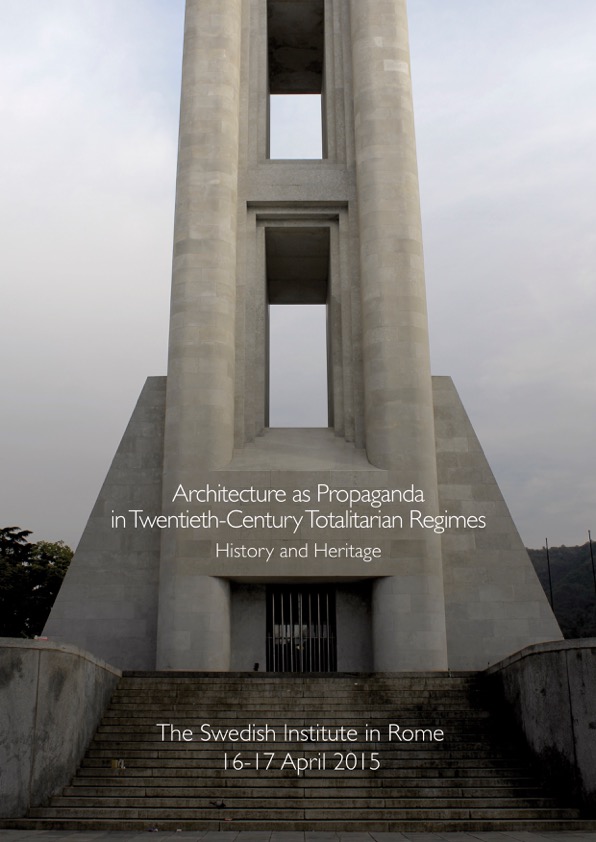
Architecture as Propaganda in Twentieth-Century Totalitarian Regimes. History and Heritage

Conference at the Swedish Institute in Rome, 16-17 April 2015

Håkan Hökerberg, Istituto Svedese di Studi Classici a Roma, hkb@isvroma.org

The aim of the conference is to map and analyse the rhetorical architecture of twentieth-century European totalitarian regimes. Essential issues are to define rhetorical architecture, to examine if certain architectural styles tend to be associated with totalitarian regimes and how ideological propaganda is promulgated through architecture. An important aspect is how rhetorical architecture left behind by totalitarian regimes may be integrated into present day democratic states, and its potential as modern urban heritage. The current attitude toward fascist architecture in Italy will be discussed in relation to European countries that have a similar history but have developed different approaches to their controversial architectural heritage. The aim is to illustrate the consequences of these different approaches and also how history is used, what processes shape national identity and how heritage is produced.

The conference is organized by Håkan Hökerberg (Istituto Svedese di Studi Classici a Roma).

Download conference programme: Programme_Architecture_as_Propaganda

Poster

BZ ’18-’45: Un percorso espositivo nel Monumento alla Vittoria. Bozen/Bolzano, Italia

Piero Sassi, Bauhaus-Universität Weimar, piero.sassi@uni-weimar.de

Uno dei capitoli più importanti e difficili della storia del fascismo italiano è quello rappresentato dall’italianizzazione forzata dell’Alto Adige. A Bolzano, l’urbanistica e l’architettura furono parti integranti di questo processo e lasciarono tracce molto profonde, tuttora facilmente riconoscibili. Uno dei simboli delle politiche urbane di quegli anni è il Monumento alla Vittoria, progettato dall’architetto Marcello Piacentini e costruito tra il 1926 e il 1928. Questa importante testimonianza del periodo dittatoriale è stata recentemente restaurata. Oggi ospita nel suo piano interrato il percorso espositivo “BZ ’18–’45. Un monumento, una città, due dittature” che, all’interno di una riflessione ampia sulle dittature fascista e nazionalsocialista, analizza gli interventi architettonici e urbanistici realizzati a Bolzano durante il Ventennio. Quello del Monumento alla Vittoria non rappresenta un caso isolato. A Predappio, città natale di Mussolini, si discute oramai da diverso tempo della possibilità di realizzare un museo sul fascismo nella ex Casa del Fascio e dell’Ospitalità (post del 28.10.2014). Queste iniziative, se connesse ad altre simili a livello internazionale, potrebbero rappresentare i primi e importanti passi di un percorso verso la rielaborazione europea della difficile eredità urbanistica – ma non solo – del fascismo italiano.

Bozen_1

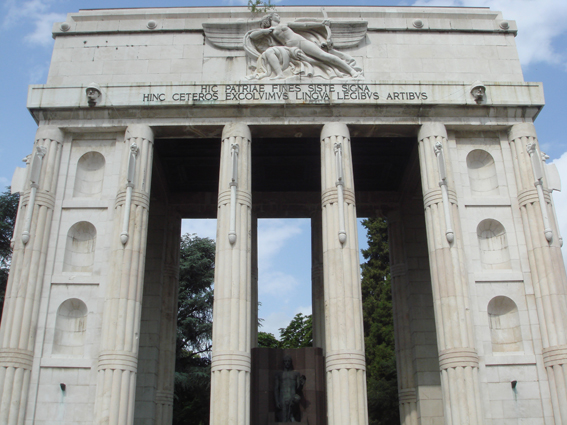
Monumento alla Vittoria, Bolzano. Realizzato tra il 1926 e il 1928. Foto: Harald Bodenschatz 2008

Bozen_2

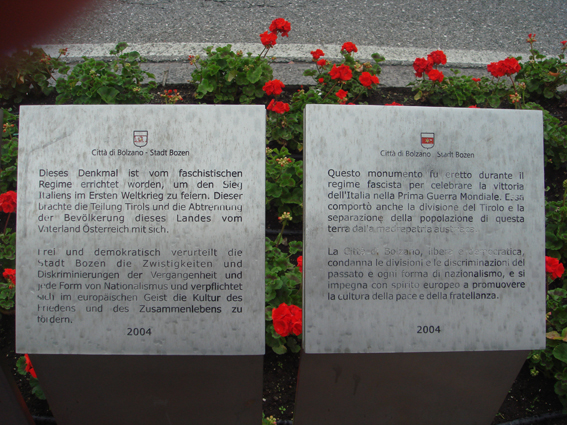
Difficile tentativo di presa di posizione da parte della Città di Bolzano rispetto al Monumento alla Vittoria, nel 2004. Foto: Harald Bodenschatz 2008


Informazioni sul tema:

auf Deutsch

Museen Südtirol
http://www.museen-suedtirol.it/de/museen.asp?muspo_id=1444

Siegesdenkmal
http://www.siegesdenkmal.com/de.html

Das war überfällig, Taz, 12.08.2014
http://www.taz.de/1/berlin/tazplan-kultur/artikel/?ressort=ku&dig=2014%2F08%2F12%2Fa0105&cHash=38d4fb4e12f2f3b809c2e57c4017228b

in italiano

Musei in Alto Adige
http://www.musei-altoadige.it/it/musei.asp?muspo_id=1444

Monumento alla Vittoria
http://www.monumentoallavittoria.com/it.html

El urbanismo de las dictaduras – Experiencias europeas entre 1920 y 1950

Lecture by Max Welch Guerra, Goethe-Institut Santiago de Chile

Max Welch Guerra, Bauhaus-Universität Weimar, max.welch@uni-weimar.de

25.3.2015, 19:30
Holanda 100, Providencia, Santiago de Chile
Moderator: Mauro Basaure (Johann Wolfgang Goethe Universität, Frankfurt)
Free entry

The lecture bases on the book “Urbanism and Dictatorship – A European Perspective”, edited by Harald Bodenschatz, Piero Sassi and Max Welch Guerra

Read More >

Max Welch Guerra Urbanism_and_Dictatorship_EFlyer (2)

Berlins historisches Zentrum – Wunden schließen mit der Liebe zu Mitte

Article by Harald Bodenschatz in: Tagesspiegel, 7.3.2015

Harald Bodenschatz, Technische Universität Berlin, harald.bodenschatz@tu-berlin.de

„Berlins historisches Zentrum ist ein Ort der jüngsten Vergangenheit – vor allem die beiden deutschen Diktaturen haben ihn geprägt. Bei den Überlegungen für die künftige Gestaltung wird das bisher kaum gewürdigt.“ Read More >

Berlin_Mitte_hb_2010_a

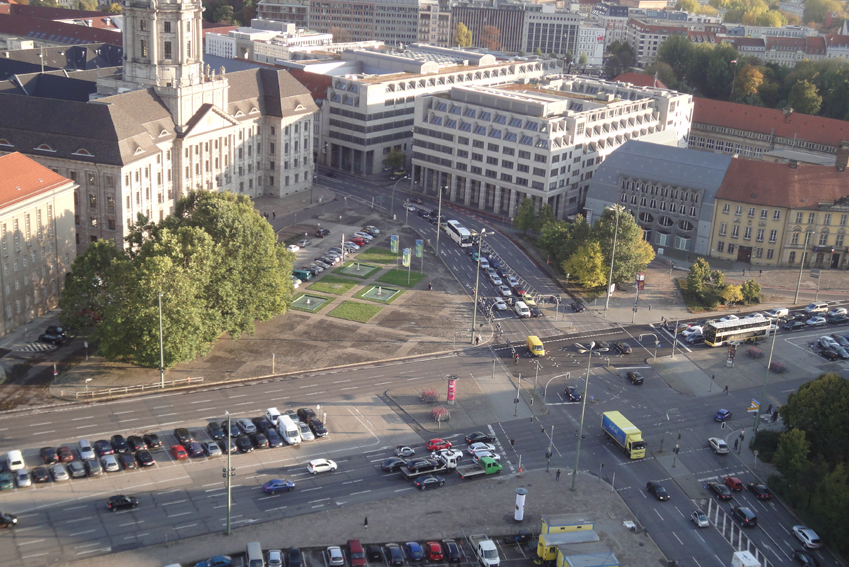
Wo einst das Zentrum des mittelalterlichen Berlin war, erstreckt sich heute eine unwirtliche Autoverkehrslandschaft – ein Produkt beider Diktaturen. Foto: Harald Bodenschatz 2010

Urbanism and Dictatorship – A European Perspective

Publication edited by Harald Bodenschatz, Piero Sassi and Max Welch Guerra (Birkhäuser Verlag, Bauwelt Fundamente 153, 2015)

Harald Bodenschatz, Technische Universität Berlin, harald.bodenschatz@tu-berlin.de
Piero Sassi, Bauhaus-Universität Weimar, piero.sassi@uni-weimar.de
Max Welch Guerra, Bauhaus-Universität Weimar, max.welch@uni-weimar.de

Urban design under European dictatorships in the first half of the twentieth century must be considered in an international context, as the professional and cultural exchange between European countries was – beyond conflicts and political orientations – very intensive. This European perspective allows us to recognize the specificities of old and new forms of dictatorship!

Download flyer: Urbanism_and_Dictatorship_2015

Urbanism_and_Dictatorship