Skip to content

Posts from the ‘Events’ Category

European Urbanism in the 20th Century. The Tension between Real and Written History

Lecture series at the Bauhaus University Weimar

Piero Sassi, Bauhaus-Universität Weimar, piero.sassi@uni-weimar.de
Max Welch Guerra, Bauhaus-Universität Weimar, max.welch@uni-weimar.de

The debate on a common European identity is by no means novel. However, over the past few years the escalation of multiple crises and the consequent discussion about the future of the European Union have extended this debate to ever larger segments of society. A shared European history is a fundamental part of the European identity. Discussing it is today more important than ever.

Professional and cultural exchange throughout Europe was very intense in the 20th century. It had a strong effect on urbanism in the individual countries. Therefore, the history of urbanism in Europe during the 20th century should be discussed in an international context, as a shared history. In doing so, it shouldn’t be neglected that dictatorships, wars, oppression and exile, that strongly characterized 20th century history, produced migration flows. These increased the exchange between the European debate and those of overseas countries, for instance in South and North America.

Within the lecture series, we will tackle some major issues, such as housing policies, large-scale projects and urban renewal in different geographical contexts (Germany, Portugal, Serbia, Spain and Argentina) and historical periods. On the one hand, this will allow to underline similarities between case studies and to recognize the exchange of models, experts and know-how between different countries. On the other hand, by considering the single case study in a broader international context, this will make it possible to understand its peculiarities. Doing so, the lecture will take on a European perspective. Lectures will be given both by scholars of the BUW and by invited guests. Results of ongoing research projects will be discussed in order to provide an overview of contemporary debate on 20th century urbanism, in Germany and in Europe. Topics and case studies will follow a chronological order. In order to receive credits and an attendance certificate, students are required to pass a written examination at the end of the course.
Sponsored by the Federal Ministry of Education and Research

Download programme > Urbanism_in_Europe_2016
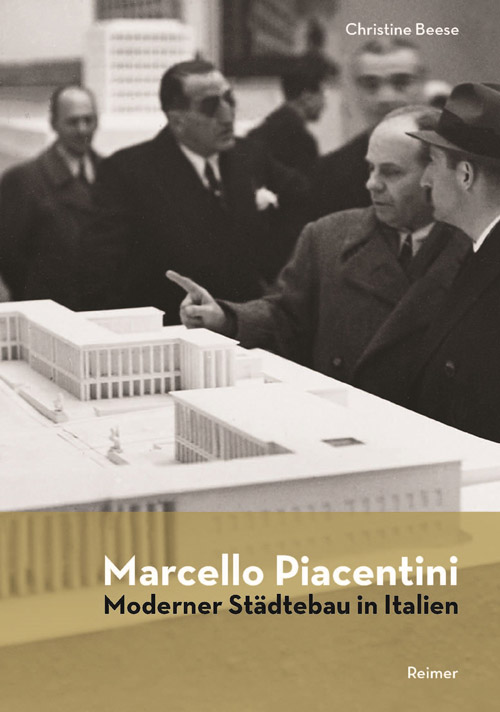
Marcello Piacentini. Moderner Städtebau in Italien

Book presentation
Thursday, March 17, 2016. 6 pm
Bücherbogen, Savignyplatz, Stadtbahnbogen 593, 10632 Berlin

Harald Bodenschatz, Technische Universität Berlin, harald.bodenschatz@tu-berlin.de

Benito Mussolini ist jedem ein Begriff, aber wer – abgesehen von einigen Spezialisten – kennt schon Marcello Piacentini, den einflussreichsten Architekten des faschistischen Italiens? Häufig wird Piacentini mit Albert Speer verglichen, dabei trennt beide beinahe mehr als sie verbindet. Beide strebten zwar danach, der jeweiligen Diktatur einen eigenen Stil zu verleihen, doch war Piacentini, im Gegensatz zu Speer, auch vor und nach der Zeit des Faschismus aktiv, bestimmte als Professor und Publizist die architektonische Debatte seiner Zeit und stützte seinen Erfolg nicht nur auf staatliche, sondern auch auf privatwirtschaftliche Aufträge. Dabei war Piacentini nicht nur Architekt, sondern vor allem ein Experte des Städtebaus, der seine Positionen im Kontext internationaler Leitbilder entwickelte. Nun ist endlich ein Buch erschienen, das diese Schlüsselfigur des europäischen Städtebaus der ersten Hälfte des 20. Jahrhunderts dem deutschen Publikum kenntnisreich vorstellt. Das Buch ist im Reimer-Verlag 2016 erschienen.

Begrüßung:
Ruthild Spangenberg
Bücherbogen am Savignyplatz
Prof. Dr. Claudia Kromrei
Werkbund Berlin

Es sprechen:
Dr. Christine Beese
Autorin und wissenschaftliche Mitarbeiterin des Kunsthistorischen Instituts der Freien Universität Berlin
Prof. Dr. Wolfgang Sonne
Doktorvater von Christine Beese, TU Dortmund, Lehrstuhl für Geschichte und Theorie der Architektur
Prof. Dr. Harald Bodenschatz
TU Berlin, Center for Metropolitan Studies, Vorstandsmitglied des Deutschen Werkbunds Berlin

Download invitation > Einladung Buchpräsentation Piacentini

Cover

Sutcliffe Price 2016

Piero Sassi, Bauhaus-Universität Weimar, piero.sassi@uni-weimar.de

In honor of Anthony Sutcliffe (founding member of IPHS and Planning Perspectives), IPHS has created an award to recognize the best dissertation in the field of planning history written in English and completed during the two years preceding the biennial conference. There is no restriction on topic, but submissions which most directly and innovatively address the internationalism of the modern planning movement in line with much of Sutcliffe’s work are especially welcome. The prize was awarded first time at the July 2014 conference in St. Augustine, Florida, USA.

Doctoral dissertations completed during 2014 and 2015 are eligible. Self-nominations or nominations from dissertation advisors (on behalf of their students) are welcomed. The award winner will receive free conference registration for the 2016 conference in Delft and a $100 prize. All submissions must include the dissertation in single file PDF format, a brief biography of the student with full contact details, identification of the main academic advisor(s) also with contact details, and a letter of affirmation by the dissertation advisor (or some other official university documentation) that the dissertation was completed and successfully passed/defended in the eligibility period, calendar years 2014-2015.

Nomination should be sent to Sutcliffe Award Chair: Prof. Dr. José Luis Sáinz Guerra, Valladolid/Spain: jlsainzg@hotmail.com before 15th of March 2016.
The winner will be informed in April 2016.

George Matei Cantacuzino – eine hybride Moderne

Exhibition and Bauhaus-ARGUMENTE event

Ines Weizman, Bauhaus-Universität Weimar, ines.weizman@uni-weimar.de

Die Fakultät Architektur und Urbanistik der Bauhaus-Universität Weimar startet mit einer Ausstellung über den rumänischen Architekten Cantacuzino in das neue Jahr. Vom 6. bis 31. Januar 2016 zeigt »George Matei Cantacuzino – eine hybride Moderne« einen Querschnitt durch das Werk des kosmopolitischen Architekten, Malers und Intellektuellen. Cantacuzino (1899-1960) gilt als die integrative Figur der Moderne im Rumänien der 1930er Jahre. Angesichts jener Zeit der Extreme erscheint sein Plädoyer für die Verknüpfung von Tradition und Moderne ebenso bemerkenswert wie seine intellektuelle Redlichkeit.

Cantacuzino, geboren in Wien, ist mit Rumänisch, Französisch und Deutsch aufgewachsen. Er hat als Steinmetz gearbeitet. Während seines Studiums in Paris begeisterte er sich für Palladio, Goethe und Valéry. Angeregt von der Groupe des Architectes Modernes um Auguste Perret, entfaltete er eine „klassische Haltung“ – in der Tradition von Schinkel, Semper, Wagner und Loos. Er wirkte als Korrespondent der renommierten Architekturzeitschrift L´Architecture d´Aujourd´hui (als Julius Posener deren Sekretär war), war Ehrenmitglied des Royal Institute of British Architects und Ehrenbürger von New York.

Die Ausstellung war bereits zu sehen in der Architekturgalerie am Weissenhof Stuttgart, im Architekturmuseum der TU Berlin, im Architekturschaufenster Karlsruhe, in der Galerie des Generalkonsulats von Rumänien in München und im Romanian Cultural Institute in London.

Anlässlich der Ausstellungseröffnung kommen am 6. Januar, 17 Uhr im Oberlichtsaal des Hauptgebäudes, Serban Cantacuzino, Architekturkritiker, Denkmalpfleger und Sohn von G.M. Cantacuzino, und Dan Teodorovici, Architekturhistoriker und Kurator, über die Aktualität des Werkes von George Matei Cantacuzino im Rahmen der Reihe Bauhaus ARGUMENTE ins Gespräch. Das Gespräch wird von Prof. Dr. Ines Weizman moderiert. Im Mittelpunkt steht eine geschichts- und kulturbewusste Spielart der Moderne am südöstlichen Rand Europas.

Serban Cantacuzino unternimmt eine kritische und zugleich leidenschaftliche Tour de force durch das ereignisreiche Leben und vielschichtige Werk seines Vaters. Er schlägt dabei den Bogen von den geopolitischen Kontexten des 20. Jahrhunderts (mit den zwei Weltkriegen, dem Faschismus und dem Kommunismus) über die Liebe zu Palladio und einem kontextuellen Architekturpluralismus bis zur Bedeutung G.M. Cantacuzinos in der heutigen postkommunistischen Gesellschaft Rumäniens.

Dan Teodorovici wird zwei Momente seiner Arbeit über G.M. Cantacuzino beleuchten: Zum einen wird er von seine detektivischen Spurensuche berichten, die versucht, G.M. Cantacuzinos „klassische Haltung“ zu rekonstruieren und in den kulturellen und politischen Kontext einzuordnen. Zum anderen wird er die G.M. Cantacuzinos Versuch, die Ästhetik der Moderne ethisch zu verankern und sie mit der Tradition zu verknüpfen, auf seine heutige Anschlussfähigkeit befragen.

Eckdaten
Ausstellung »George Matei Cantacuzino – eine hybride Moderne«
6. bis 31. Januar 2016
Hauptgebäude der Bauhaus-Unverstität Weimar
Geschwister-Scholl-Straße 8, 99423 Weimar
Mo-Fr 9-19 Uhr
Sa/So 9-16 Uhr

Eröffnung mit
Bauhaus ARGUMENTE: Serban Cantacuzino vs. Dan Teodorovici
Moderation Prof. Dr. Ines Weizman.

6. Januar 2016, 17:00h
Oberlichtsaal im Hauptgebäude der Bauhaus-Universität Weimar

Cantacuzino_hybride Moderne

Urban design and dictatorship in the 20th century: Italy, Portugal, the Soviet Union, Spain and Germany. History and Historiography

Conference Publication

Piero Sassi, Bauhaus-Universität Weimar, piero.sassi@uni-weimar.de

For decades in Germany, historical research on dictatorial urban design in the first half of the 20th century focused on the National Socialist period. Studies on the urban design practices of other dictatorships remained an exception. This has changed. Meanwhile, the urban production practices of the Mussolini, Stalin, Salazar, Hitler and Franco dictatorships have become the subject of comprehensive research projects. Recently, a research group that studies dictatorial urban design in 20th century Europe has emerged at the Bauhaus-Institut für Geschichte und Theorie der Architektur und der Planung. The group is already able to refer to various research results.

Part of the research group’s self-conception is the assumption that the urban design practices of the named dictatorships can only be properly understood from a European perspective. The dictatorships influenced one another substantially. Furthermore, the specificities of the practices of each dictatorship can only be discerned if one can compare them to those of the other dictatorships. This approach requires strict adherence to the research methods of planning history and urban design theory. Meanwhile, these methods must be opened to include those of general historical studies.

With this symposium, the research group aimed to further qualify this European perspective. The aim was to pursue an inventory of the various national historiographies on the topic of “urban design and dictatorship”. This inventory should offer an overview on the general national level of historical research on urban design as well as on the level of particular urban design projects, persons or topics.

The symposium took place in Weimar, November 21-22, 2013. It was organized by Harald Bodenschatz, Piero Sassi and Max Welch Guerra and funded by the DAAD (German Academic Exchange Service).

About the Internationality of Urbanism: The Influence of International Town Planning Ideas upon Marcello Piacentini’s Work
Christine Beese
Kunsthistorisches Institut – Freie Universität Berlin – Germany

Landscape and City during Fascism: Enrico del Debbio’s Foro Mussolini
Maria Luisa Neri
Università di Camerino – Scuola di Architettura e Design – Ascoli Piceno – Italy

Planning the Industrialization. The Technical and Theoretical Toolbox for the Post-War Program for the Industrial Development Areas of Southern Italy
Nicla Dattomo
Università Iuav di Venezia – Italy

Restelo Neighbourhood: Expanding the Capital of the Empire with the First Portuguese Urban Planner
Patrícia Bento d’Almeida
Instituto Universitário de Lisboa – Portugal

Portuguese Social Housing under Dictatorship. A Morphological Analysis of Some Residential Agglomerations in Lisbon (1933-1950)
Maria Amélia Cabrita
Architecture – ISCTE, Lisbon, Portugal

Restelo in Lisbon – The Non-implementation of the Original Urban Design by Faria da Costa during the Dictatorship of António de Oliveira Salazar
Salete A. F. Cravo
Instituto Universitário de Lisboa – Portugal

Granite on the Ground: Former Nazi Party Rally Grounds, Nuremberg/Germany. A brief introduction
Marie Luise Birkholz
Bauhaus-Universität Weimar, Germany

Download full papers
Download conference program > flyer_symposium

symposium-1

Urbanistica e dittatura. Otto osservazioni / Städtebau und Diktatur. Acht Anmerkungen

Harald Bodenschatz, Technische Universität Berlin, harald.bodenschatz@tu-berlin.de

Presentation held by Harald Bondeschatz on October 24, 2015 at the exhibition “Cesare Valle. Un’altra modernità: Architettura in Romagna”, Forlì (Italy).

Download presentation > otto osservazioni_HB_it ; Acht Anmerkungen_HB_de

Chi conosce Cesare Valle? Wer kennt schon Cesare Valle?

Harald Bodenschatz, Technische Universität Berlin, harald.bodenschatz@tu-berlin.de

Nonostante il loro lavoro sia fondamentale per lo sviluppo e la comprensione dell’architettura europea del periodo interbellico, la maggior parte degli architetti attivi durante la dittatura di Mussolini vengono tuttora trascurati. Questo atteggiamento sta però cambiando. Nel 2015 il lavoro dell’architetto romano Cesare Valle (1902-2000) è stato ampliamente illustrato in una mostra allestita a Forlì, incentrata soprattutto sulla sua attività in Romagna. Gli edifici progettati da Cesare Valle si sottraggono, come del resto quelli di molti altri architetti italiani, alle troppo facili categorie “tradizione” e “modernità”. Oltre a quella architettonica, la loro dimensione urbana è spesso molto caratterizzante. Il catalogo della mostra, molto esaustivo e ben redatto, è stato curato da Ulisse Tremonti: “Cesare Valle. Un’altra modernità: architettura in Romagna” (Bononia University Press 2015).

Noch immer werden die meisten Architekten der Mussolini-Diktatur übersehen, wenngleich ihr Werk für die Entwicklung und das Verständnis der europäischen Architektur der Zwischenkriegszeit unverzichtbar ist. Aber langsam ändert sich das. 2015 wurde in einer Ausstellung in Forlì das Werk des römischen Architekten Cesare Valle (1902-2000) unter besonderer Berücksichtigung von dessen Aktivitäten in der Romagna gezeigt. Die von Cesare Valle entworfenen Bauten entziehen sich, wie auch viele Bauten anderer italienischer Architekten, den einfachen Schubladen „Tradition“ und „Moderne“. Sie haben aber oft eine städtebauliche Dimension. Im Rahmen der Ausstellung erschien ein ausgezeichneter Katalog, herausgegeben von Ulisse Tramonti: „Cesare Valle. Un’altra modernità: architettura in Romagna“ (Bononia University Press 2015).

DSC04445

Manifesto della mostra su Cesare Valle sulla facciata del Palazzo Comunale di Forlì. Ottobre 2015. Plakat zur Ausstellung über Cesare Valle am Rathaus von Forlì, Oktober 2015. Foto: Harald Bodenschatz, CC BY-NC-ND 4.0

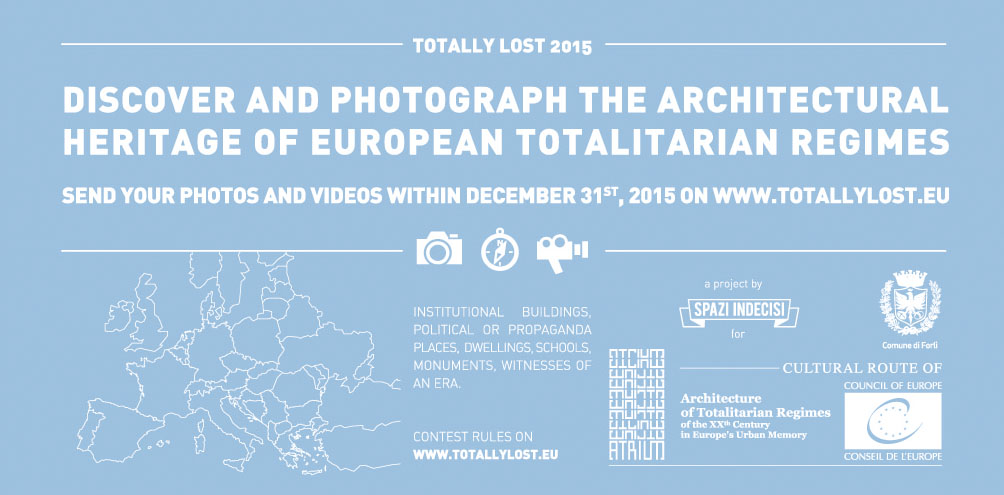
TOTALLY LOST 2015

The photographic and video exploration of the architecture of totalitarian regimes of the XX century in Europe
Organized by Spazi Indecisi and the Cultural Route “ATRIUM – Architecture of Totalitarian Regimes of the XX Century in Europe’s Urban Memory”

Michele Pancaldi, Comune di Forlì, michele.pancaldi@comune.forli.fc.it

Totally-Lost-2015

Spazi Indecisi and the Cultural Route “ATRIUM – Architecture of Totalitarian Regimes of the XX Century in Europe’s Urban Memory” announce the second edition of Totally Lost: a European photo and video exploration aimed at discovering and mapping the architectural heritage of European Totalitarian Regimes of the XX Century in Europe, that lie today in abandonment.

Through the lenses of photographers, video-makers and urban explorers Totally Lost aims at showing how these places are not “totally lost”, as they represent fragments to be reconnected in a network of new meanings to give and new contents to generate. The purpose of this operation is not to forget the past, but to critically understand its heritage, reconsider it critically in the present time, and pass it on to the future.

The object of the 2015 edition of the call is to expand and enrich the online mapping that was created with the material received during the first edition, and to collect photos and videos that will be included in a public travelling exhibit.
In order to take part to Totally Lost upload your photos and videos by December 31st, 2015.

Read more>

volantino 2015 2

75 Jahre Flüchtlingsland Portugal

Event organized by the Deutscher Werkbund Berlin in collaboration with the DFG research project “City Production by Iberian Dictatorships in the European Context” (Bauhaus University Weimar, Technical University Berlin and University of Kassel)

Harald Bodenschatz, Technische Universität Berlin, harald.bodenschatz@tu-berlin.de

November 27, 2015, 6 pm
Werkbund Galerie, Goethestraße 13, Berlin

Vor 75 Jahren, 1940, nach der Eroberung von Paris durch die deutsche Wehrmacht, war Lissabon der letzte Ort der Hoffnung für all diejenigen, die vor der nationalsozialistischen Gewalt fliehen mussten, die letzte Chance, Europa zu verlassen. Wohl etwa 100.000 Menschen flohen in ein Land, das vor 1940 kaum bekannt war, ein Land, das selbst von einem Diktator reagiert wurde: António de Oliveira Salazar. Unter diesen Flüchtlingen waren auch zahlreiche Prominente, etwa Hannah Arendt, Alfred Döblin, Lion Feuchtwanger, Siegfried Kracauer, Golo und Heinrich Mann, Antoine de Saint-Exupéry. 1940 war aber auch das Jahr, in dem sich die Salazar-Diktatur wie nie zuvor und danach feierte – mit Blick auf die große Geschichte Portugals. Die prächtige „Ausstellung über die portugiesische Welt“ direkt vor dem Hieronymiten-Kloster in Belem, ein Höhepunkt der Jahrhundertfeier der Salazar-Diktatur, prägte Lissabon – bis heute, und sie wurde auch von den Flüchtlingen wahrgenommen, oft mit großer Bewunderung. Dieses doppelte Ereignis vor 75 Jahren, mit dem Lissabon europäische Geschichte schrieb, das Portugal vom Rand Europas in dessen Zentrum rückte, ist heute fast vollständig vergessen. Die Veranstaltung des Deutschen Werkbundes Berlin soll nicht nur Lissabon 1940 wieder in Erinnerung rufen, sondern auch all den Portugiesen unseren Dank aussprechen, die damals die Flüchtlinge unterstützt haben.

Begrüßung Gerwin Zohlen, Vorstand Deutscher Werkbund Berlin
Einführung Harald Bodenschatz
Das Jahr 1940: Portugal rückt ins Zentrum Europas Christian von Oppen
Das Jahr 1940: Die „Ausstellung der portugiesischen Welt“ feiert Salazars Diktatur Harald Bodenschatz
Portugal 1933-1945: Exilstation am Rande Europas Christa Heinrich
Das Jahr 1940: Flüchtlingsnotizen aus Lissabon/Notizen über Flüchtlinge in Lissabon: Alfred Döblin, Antoine de Saint-Exupéry, Erika Mann Max Welch Guerra

Moderation Piero Sassi

Urbanism and Dictatorship – A European Perspective

Book presentation
Saturday, October 24, 2015. 4:30 pm
Ex GIL building, V.le della Libertà 2, Forlì (Italy)

Organized by the Cultural Route “ATRIUM – Architecture of Totalitarian Regimes of the XX Century in Europe’s Urban Memory”

Guests: the editors Harald Bodenschatz, Piero Sassi and Max Welch Guerra; Patrick Leech (Cultural Route ATRIUM and University of Bologna) and Roberto Balzani (University of Bologna)

Piero Sassi, Bauhaus-Universität Weimar, piero.sassi@uni-weimar.de

Read more >

Urbanism_and_Dictatorship