Skip to content

Posts from the ‘Italy’ Category

Urban design and dictatorship in the 20th century: Italy, Portugal, the Soviet Union, Spain and Germany. History and Historiography

Conference Publication

Piero Sassi, Bauhaus-Universität Weimar, piero.sassi@uni-weimar.de

For decades in Germany, historical research on dictatorial urban design in the first half of the 20th century focused on the National Socialist period. Studies on the urban design practices of other dictatorships remained an exception. This has changed. Meanwhile, the urban production practices of the Mussolini, Stalin, Salazar, Hitler and Franco dictatorships have become the subject of comprehensive research projects. Recently, a research group that studies dictatorial urban design in 20th century Europe has emerged at the Bauhaus-Institut für Geschichte und Theorie der Architektur und der Planung. The group is already able to refer to various research results.

Part of the research group’s self-conception is the assumption that the urban design practices of the named dictatorships can only be properly understood from a European perspective. The dictatorships influenced one another substantially. Furthermore, the specificities of the practices of each dictatorship can only be discerned if one can compare them to those of the other dictatorships. This approach requires strict adherence to the research methods of planning history and urban design theory. Meanwhile, these methods must be opened to include those of general historical studies.

With this symposium, the research group aimed to further qualify this European perspective. The aim was to pursue an inventory of the various national historiographies on the topic of “urban design and dictatorship”. This inventory should offer an overview on the general national level of historical research on urban design as well as on the level of particular urban design projects, persons or topics.

The symposium took place in Weimar, November 21-22, 2013. It was organized by Harald Bodenschatz, Piero Sassi and Max Welch Guerra and funded by the DAAD (German Academic Exchange Service).

About the Internationality of Urbanism: The Influence of International Town Planning Ideas upon Marcello Piacentini’s Work
Christine Beese
Kunsthistorisches Institut – Freie Universität Berlin – Germany

Landscape and City during Fascism: Enrico del Debbio’s Foro Mussolini
Maria Luisa Neri
Università di Camerino – Scuola di Architettura e Design – Ascoli Piceno – Italy

Planning the Industrialization. The Technical and Theoretical Toolbox for the Post-War Program for the Industrial Development Areas of Southern Italy
Nicla Dattomo
Università Iuav di Venezia – Italy

Restelo Neighbourhood: Expanding the Capital of the Empire with the First Portuguese Urban Planner
Patrícia Bento d’Almeida
Instituto Universitário de Lisboa – Portugal

Portuguese Social Housing under Dictatorship. A Morphological Analysis of Some Residential Agglomerations in Lisbon (1933-1950)
Maria Amélia Cabrita
Architecture – ISCTE, Lisbon, Portugal

Restelo in Lisbon – The Non-implementation of the Original Urban Design by Faria da Costa during the Dictatorship of António de Oliveira Salazar
Salete A. F. Cravo
Instituto Universitário de Lisboa – Portugal

Granite on the Ground: Former Nazi Party Rally Grounds, Nuremberg/Germany. A brief introduction
Marie Luise Birkholz
Bauhaus-Universität Weimar, Germany

Download full papers
Download conference program > flyer_symposium

symposium-1

Urbanistica e dittatura. Otto osservazioni / Städtebau und Diktatur. Acht Anmerkungen

Harald Bodenschatz, Technische Universität Berlin, harald.bodenschatz@tu-berlin.de

Presentation held by Harald Bondeschatz on October 24, 2015 at the exhibition “Cesare Valle. Un’altra modernità: Architettura in Romagna”, Forlì (Italy).

Download presentation > otto osservazioni_HB_it ; Acht Anmerkungen_HB_de

Chi conosce Cesare Valle? Wer kennt schon Cesare Valle?

Harald Bodenschatz, Technische Universität Berlin, harald.bodenschatz@tu-berlin.de

Nonostante il loro lavoro sia fondamentale per lo sviluppo e la comprensione dell’architettura europea del periodo interbellico, la maggior parte degli architetti attivi durante la dittatura di Mussolini vengono tuttora trascurati. Questo atteggiamento sta però cambiando. Nel 2015 il lavoro dell’architetto romano Cesare Valle (1902-2000) è stato ampliamente illustrato in una mostra allestita a Forlì, incentrata soprattutto sulla sua attività in Romagna. Gli edifici progettati da Cesare Valle si sottraggono, come del resto quelli di molti altri architetti italiani, alle troppo facili categorie “tradizione” e “modernità”. Oltre a quella architettonica, la loro dimensione urbana è spesso molto caratterizzante. Il catalogo della mostra, molto esaustivo e ben redatto, è stato curato da Ulisse Tremonti: “Cesare Valle. Un’altra modernità: architettura in Romagna” (Bononia University Press 2015).

Noch immer werden die meisten Architekten der Mussolini-Diktatur übersehen, wenngleich ihr Werk für die Entwicklung und das Verständnis der europäischen Architektur der Zwischenkriegszeit unverzichtbar ist. Aber langsam ändert sich das. 2015 wurde in einer Ausstellung in Forlì das Werk des römischen Architekten Cesare Valle (1902-2000) unter besonderer Berücksichtigung von dessen Aktivitäten in der Romagna gezeigt. Die von Cesare Valle entworfenen Bauten entziehen sich, wie auch viele Bauten anderer italienischer Architekten, den einfachen Schubladen „Tradition“ und „Moderne“. Sie haben aber oft eine städtebauliche Dimension. Im Rahmen der Ausstellung erschien ein ausgezeichneter Katalog, herausgegeben von Ulisse Tramonti: „Cesare Valle. Un’altra modernità: architettura in Romagna“ (Bononia University Press 2015).

DSC04445

Manifesto della mostra su Cesare Valle sulla facciata del Palazzo Comunale di Forlì. Ottobre 2015. Plakat zur Ausstellung über Cesare Valle am Rathaus von Forlì, Oktober 2015. Foto: Harald Bodenschatz, CC BY-NC-ND 4.0

Urbanism and Dictatorship – A European Perspective

Book presentation
Saturday, October 24, 2015. 4:30 pm
Ex GIL building, V.le della Libertà 2, Forlì (Italy)

Organized by the Cultural Route “ATRIUM – Architecture of Totalitarian Regimes of the XX Century in Europe’s Urban Memory”

Guests: the editors Harald Bodenschatz, Piero Sassi and Max Welch Guerra; Patrick Leech (Cultural Route ATRIUM and University of Bologna) and Roberto Balzani (University of Bologna)

Piero Sassi, Bauhaus-Universität Weimar, piero.sassi@uni-weimar.de

Read more >

Urbanism_and_Dictatorship

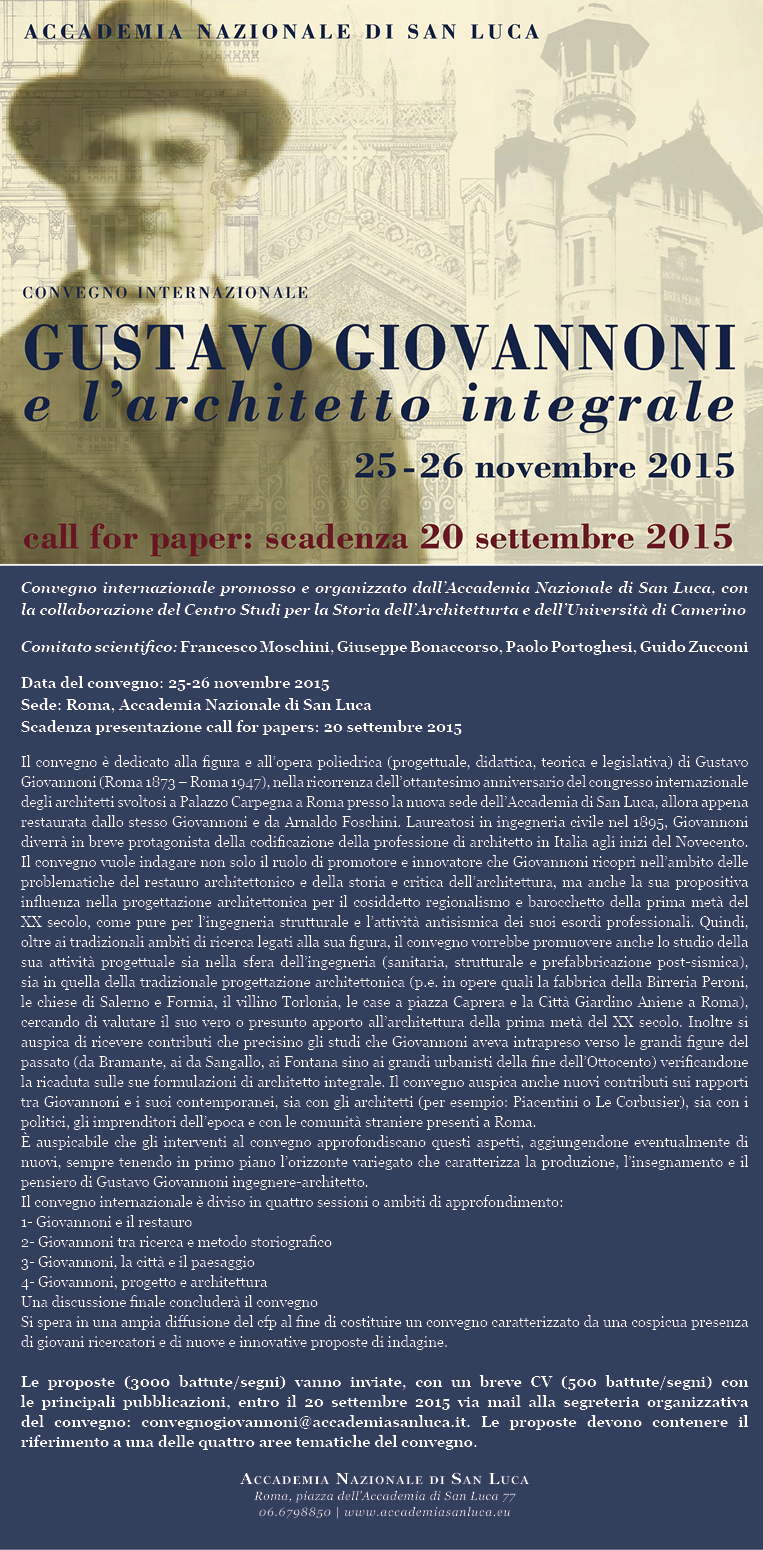
Gustavo Giovannoni e l’architetto integrale

Call for papers, international conference 25-26 November 2015, Rome
Organized by the Accademia Nazionale di San Luca with the collaboration of the Centro Studi per la Storia dell’Architettura and the University of Camerino


Harald Bodenschatz, Technische Universität Berlin, harald.bodenschatz@tu-berlin.de

Deadline for application submission is 20th September 2015.

Download call for papers > CFP_Giovannoni 2015

locandina cfp

Beyond the Great Beauty: Rescaling Heritage and Tourism

Call for papers, workshop 10-12 February 2016, Rimini
Center for Advanced Studies in Tourism (CAST), University of Bologna, with the collaboration of the ATRIUM Association

Patrick Leech, ATRIUM, patrick.leech@atriumroute.eu

The workshop will represent a framework in which to exchange ideas, experiences and research results about cultural heritage and tourism, with a particular focus both on the rescaling processes and the multilayered decision-making processes underpinning them.

Deadline for abstract submission is 30th October 2015.

Download call for papers > RSA2016_callforpapers2

Book reviews on architecture in fascist Italy

Eliana Perotti, Eidgenössische Technische Hochschule (ETH) Zürich, eliana.perotti@gta.arch.ethz.ch

Four book reviews by Mia Fuller published on 29 January 2015 in „Architectural Histories – The open access journal of the EAHN“. Read full Text >

Architetti e architetture dell’“Era Fascista”

Book by Carlo Cresti. Florence: Angelo Pontecorboli Editore, 2015.

Maria Luisa Neri, Università di Camerino, neriml@alice.it

Contents:

5 Prologo
7 Progettavano in camicia nera
35 Il Monumento della Vittoria, di Marcello Piacentini, a Bolzano
49 Enrico Del Debbio e lo ‘Stadio die Marmi’ al Foro Mussolini
69 Adalberto Libera: il vincitore die ludi architettonici die fasci littorii
91 Mario Palanti: la frenesia architettonica da fascismo
149 Il ‘Colosseo Quadrato’ dell’E42
167 Gherardo Bosio: una breve, significativa presenza nell’architettura italiana degli anni Trenta
201 Episodi di monumentalità fascista in Puglia
219 Colonie marine e montane realizzate negli anni del fascismo
235 La cancellazione die simboli del fascismo: un inutile atto di iconoclastia

Download book description> Carlo Cresti_Architetti e architetture dell’“Era Fascista”

254 pages
150 figures
14,8×21 cm
ISBN 978-­‐88-­‐97080-­‐83-­‐1
€19.50

Cover

Hans-Janssen-Prize 2014 to two doctoral dissertations on city production by Italian dictatorship!

Piero Sassi, Bauhaus-Universität Weimar, piero.sassi@uni-weimar.de

Der Hans-Janssen-Preis 2014 ging an zwei Doktorarbeiten, die sich mit der Stadtproduktion unter der Diktatur von Mussolini befassen. Es handelt sich um Christine Beeses “Neue Horizonte im Städtebau”. Die Form der Stadt bei Marcello Piacentini (1881-1960) und Simone Baders Moderne in Afrika. Asmara – Die Konstruktion einer italienischen Kolonialstadt 1889-1941.
Das UEDXX Netzwerk gratuliert Christine Beese und Simone Bader zu deren ausgezeichneten Forschungsarbeiten!

Preisverleihung Hans Janssen Preis

Urbanism and Dictatorship – A European Perspective

Book presentation
Monday, May 4, 2015. 7 pm
Bücherbogen, Savignyplatz (Berlin)

Organized by Bücherbogen am Savignyplatz and Deutscher Werkbund Berlin e.V.

Guests: the authors Christine Beese, Harald Bodenschatz, Thomas Flierl, Christian von Oppen, Piero Sassi and Max Welch Guerra

Moderation: Claudia Kromrei (Deutscher Werkbund Berlin)

Piero Sassi, Bauhaus-Universität Weimar, piero.sassi@uni-weimar.de

Der Städtebau der europäischen Diktaturen in der ersten Hälfte des 20. Jahrhunderts diente nicht nur der Herrschaftssicherung im eigenen Lande, sondern auch der Anerkennung durch die demokratischen Staaten. Nach der Machtübergabe an das nationalsozialistische Regime geriet er mehr und mehr zur Trumpfkarte im Wettbewerb unter den großen Diktaturen Europas – fast wie in der Zeit des Absolutismus. Jenseits aller Konflikte und politischer Orientierungen bestand ein intensiver fachlicher Austausch unter den Ländern Europas.

Eine nur nationale Sichtweise auf die Diktaturen ist daher nicht hinreichend. Der übergreifende Blick trägt nicht nur dazu bei, die Besonderheiten der jeweiligen Diktatur zu klären, er weist auch manch vereinfachtes Verständnis von deren Städtebau zurück. Das ist keineswegs nur von historischem Interesse: Die Auseinandersetzung mit Diktaturen ist immer auch Ausdruck unserer gesellschaftlichen Verhältnisse, unserer Erinnerungskultur, unserer Fähigkeit, alte und neue Formen von Diktatur zu erkennen – auch heute!

Das Buch diskutiert den Stand der Forschung zum Städtebau von fünf Diktaturen der ersten Hälfte des 20. Jahrhunderts und präsentiert exemplarisch neue Forschungsergebnisse.

Urbanism_and_Dictatorship