Skip to content

Posts from the ‘Events’ Category

Urban Design and Authoritarian Government – European Dictatorships in the 20th Century in International Perspective

Roundtable Discussion funded by the German Research Foundation at the University of Kassel on 25 and 26 August 2014

Uwe Altrock, Universität Kassel, altrock@asl.uni-kassel.de
Harald Kegler, Universität Kassel, harald_kegler@yahoo.com

To strengthen the network of researchers working on 20th century dictatorships in Europe and urban development, researchers from the University of Kassel, TU Berlin and Bauhaus University Weimar hosted a roundtable discussion. About 20 scholars from Germany and abroad discussed avenues for a more systematic research and perspectives for the funding of research networks. The underlying idea was that there is a lot of detailed research in a number of European countries that have witnessed dictatorships in the 20th century especially when it comes to matters of architectural form, whereas a broader approach transcending this narrow perspective is only gradually established. The following questions seem to need a more thorough reasearch approach that is truly international in nature and may allow for comparisons and for significant contributions in the context of the contemporary perception of legacies of dicatorships in a democratic environment:

How is an authoritarian system of urban design established?
Are there specific products and traditions of urban form?
How is urban design in dictatorships influenced by international exchange both in political and professional terms?
What are the specific features of the production of urban space in dictatorships when looking beyond representational urban design for the state itself?
The roundtable discussion offered an opportunity for productive interdisciplinary exchange between scholars from the fields of architecture, planning, history, history of art, preservation and political science that have all contributed to the overall theme of the roundtable discussion.
In the future, research activities of the participants will build on completed and on-going projects dealing with the situation in, among others, Germany, the Soviet Union, Italy, Spain, Portugal, and the Balkans, and linking it more actively with the activities of networks such as UEDXX.
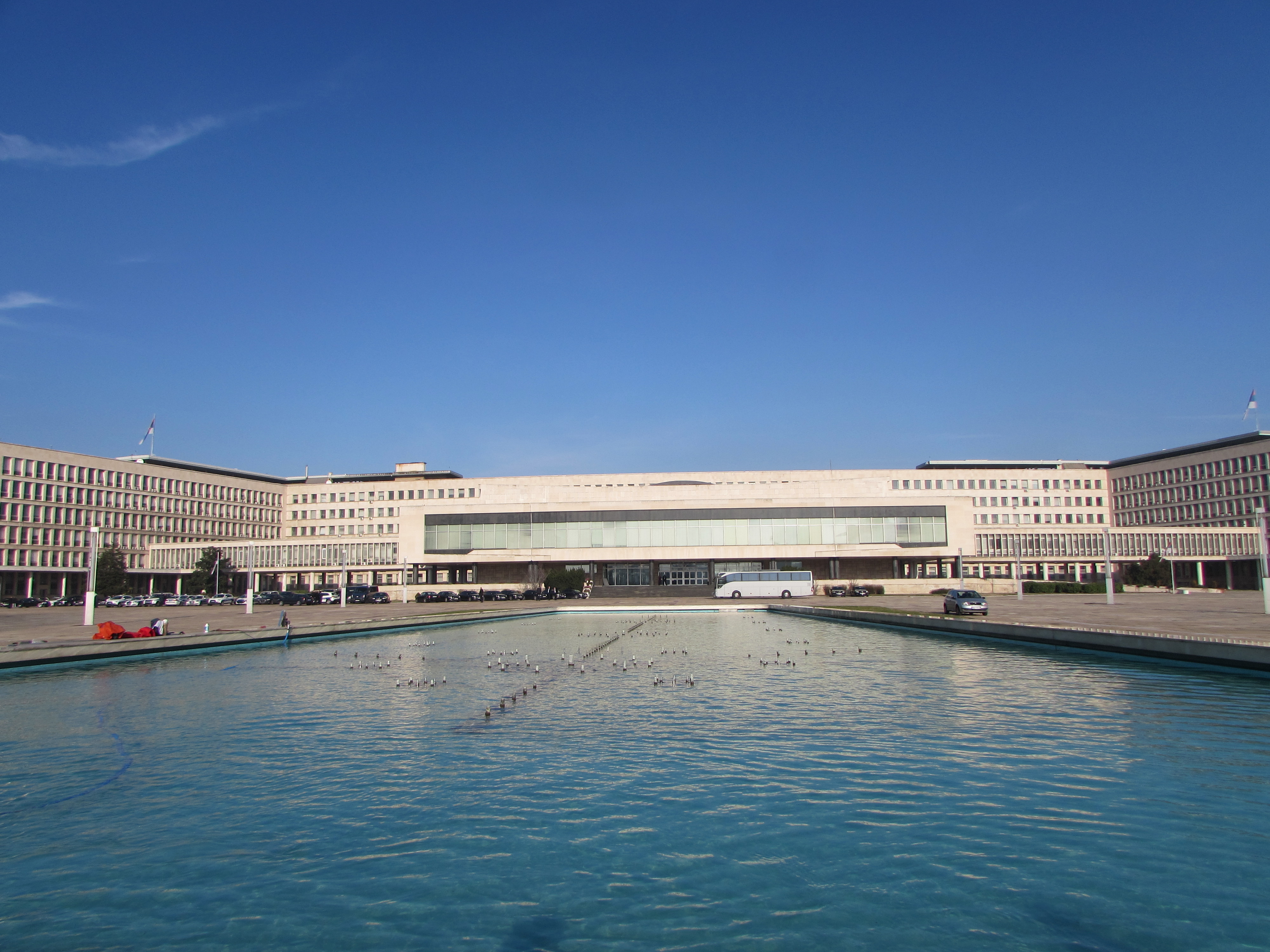
1 ehemal parlament jugoslawiens 1961

Former Parliament of Yugoslavia (inaugurated in 1961), nowadays Parliament of Serbia. The built legacy left behind by the dictatorship in former Yugoslavia was discussed during the presentation “Research on Forgotten Dictatorships” (Harald Kegler). Photograph by Harald Kegler 2014, CC BY-NC-ND 4.0
Urban Design for Mussolini, Stalin, Salazar, Hitler and Franco during the Interwar Period

Session M50 at the 12th International Conference of the European Association for Urban History (Lisbon, September 3–6, 2014)

Christian von Oppen, Technische Universität Berlin, christian.von.oppen@uni-weimar.de

Earlier this year, the UEDXX for the first time participated in the European Association for Urban History (EAUH) biannual conference in Lisbon. The EAUH conference provides a multidisciplinary forum for the diverse community of urban scholars. Following this multidisciplinary approach, Prof. Dr. Harald Bodenschatz, DI Christian von Oppen and Prof. Dr. Max Welch Guerra (founding members of the network) organized a session about urban design under the European dictatorships of the 20th Century (“Urban Design for Mussolini, Stalin, Salazar, Hitler and Franco during the Interwar Period”, M50). The session mainly focused on an international approach, which was underlined by six contributions representing six different countries.

Due to the forced repression of other European countries, as well as the cultural diplomacy of the most powerful dictatorships of the 20th century (for example, the Soviet Union, Nazi Germany, and Fascist Italy), urban history under dictatorial regimes is a topic with broad international reference. Nevertheless, this important topic is mainly discussed within the single national contexts. During the session, the different contributions made clear that the understanding of the common European history under dictatorships is determined by different national experiences. It is necessary to overcome this gap to achieve a shared understanding of the European history of the 20th Century.

Accepted papers will be published on this website.

Conference session (M50):
http://www.eauh2014.fcsh.unl.pt/index.php?conference=conference&schedConf=eauh2014&page=schedConf&op=trackPolicies

Download short report (German): Bericht_SessionM50

140829_UEDXX

The UEDXX network was presented during the networking event on Thursday, September 4, 2014, CC BY-NC-ND 4.0.

Towards a History of European Urbanism in the 20th Century: Questions and Challenges. Perspectives from Spain, France and Germany

Hacia una historia del urbanismo europeo del siglo XX: cuestiones y desafíos. Miradas desde España, Francia y Alemania

Seminar at the Instituto Universitario de Urbanística, Universidad de Valladolid

Álvaro Sevilla Buitrago, Universidad Politécnica de Madrid, alvaro.sevilla@upm.es

Cartel historia del Urbanismo.pdf

Los pasados días 17 y 18 de octubre se celebró en la Universidad de Valladolid el encuentro “Hacia una historia del urbanismo europeo del siglo XX: cuestiones y desafíos. Miradas desde España, Francia y Alemania“. El evento forma parte de un proyecto conjunto entre centros de estos países para difundir el conocimiento y la crítica de la historiografía del urbanismo europeo del siglo XX. Fue organizado por Instituto Universitario de Urbanística con la profesora María Castrillo Romón al frente y contó con la participación de los profesores Alfonso Álvarez Mora, Laurent Coudroy de Lille, Max Welch Guerra, Juan Luis de las Rivas, Charlotte Vorms, Luis Santos Ganges, Álvaro Sevilla Buitrago y José Luis Lalana, y los investigadores Marina Jiménez, Víctor Pérez Eguíluz, Miguel Fernández, Christian von Oppen y Piero Sassi. La discusión fue interesante y, por momentos, apasionada, aunando las lecturas monográficas sobre problemas regionales y nacionales con análisis comparados a nivel internacional y reflexiones sobre la propia metodología, planteamientos y objetivos de la historia del urbanismo frente a otras formas de historiografía. El encuentro permitió el intercambio de las distintas experiencias y acercamientos practicados en los centros participantes (Bauhaus-Universität Weimar, Institut d’Urbanisme de Paris y Universidad Politécnica de Madrid, además de la propia Universidad de Valladolid). A la luz del debate quedó claro que para los ponentes el conocimiento del pasado no es un mero complemento ornamental al ejercicio urbanístico, sino una auténtica oportunidad para comprender el porqué de nuestras técnicas y discursos y las dinámicas que regulan las ciudades y territorios contemporáneos.

Están disponibles en vídeo todas las sesiones del encuentro: http://institutourbanistica.com/videos-curso-uva-hacia-una-historia-del-urbanismo-europeo-del-siglo-xx-cuestiones-y-desafios/